Node.js / Performance
Node.js Parallelism vs. .NET Core: Beyond the Single Thread with Worker Threads (2026)
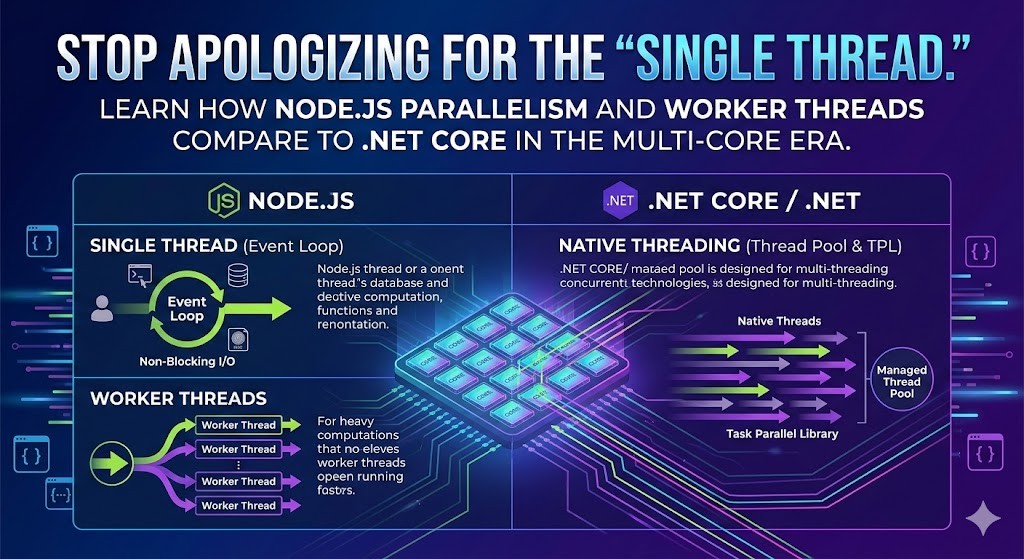
Stop apologizing for the 'Single Thread.' Learn how Node.js Parallelism and Worker Threads compare to .NET Core in the multi-core era.
Written by

Codehouse Author
For over a decade, the mantra of the Node.js developer has been "Single-Threaded and Non-Blocking." We took pride in our ability to handle thousands of concurrent I/O connections while other runtimes struggled with thread overhead. But as we move into the second half of this decade, the nature of our workloads has changed. We aren't just shifting JSON from a database to a browser anymore. We are processing images, running local AI inference, and crunching massive datasets. To survive in this new era, you must master Node.js Parallelism and Worker Threads.
Building on our foundational discussion regarding the Agent Orchestrator mindset, we see that modern applications often require heavy background processing that can't be offloaded to a separate microservice. When you need to keep your event loop "responsive" while performing a 2-second CPU calculation, you can no longer rely on simple async callbacks. You need true, kernel-level parallelism.
The Evolution from Clustering to Workers
In the early days of Node.js, our only answer to multi-core utilization was the "Cluster" module. Clustering works by spawning multiple copies of the entire Node.js process. While effective for scaling web servers, it is a "heavy" solution. Each process has its own memory heap, its own V8 instance, and its own event loop. This is where Node.js Parallelism and Worker Threads differ fundamentally. Worker threads live within the same process. They are lightweight, they share the same memory space if configured correctly, and they allow for high-frequency communication without the overhead of IPC (Inter-Process Communication).
Unlocking True Speed with SharedArrayBuffer
The "Secret Sauce" of Node.js Parallelism and Worker Threads in 2026 is the SharedArrayBuffer. Most developers make the mistake of "cloning" data between the main thread and the worker. If you have a 100MB buffer and you clone it, you've just used 200MB of RAM and wasted CPU cycles on the copy operation. By utilizing shared memory, you allow multiple threads to read and write to the same memory segment simultaneously. This is the "Zero-Copy" architecture that powers high-performance gaming engines and high-frequency trading platforms, now available directly in your Node.js backend.
Node.js vs. .NET Core: The Parallelism Face-off
As a senior engineer often navigating both ecosystems, it is critical to understand how Node.js Parallelism and Worker Threads compare to the industrial-strength threading model of .NET Core. In .NET, we have the Task Parallel Library (TPL) and managed threads that map directly to OS threads. Memory is shared by default across all threads, which is both a blessing and a curse—leading to the "lock-and-mutex" dance to avoid race conditions.
In contrast, Node.js workers are "isolated" by default. Each worker has its own V8 instance and its own heap. This makes Node.js much safer for the average developer, as you cannot accidentally corrupt the state of the main thread. However, when you need the "Raw Power" that we discuss in our Clean Architecture in .NET series, .NET Core's ability to handle millions of tiny, shared-state tasks with minimal overhead still holds the crown for massive compute-bound services. Node.js is the surgical tool for targeted parallelism; .NET Core is the heavy machinery for system-wide multi-threading.
When to Use Worker Threads (and When to Avoid Them)
A senior engineer knows that a tool is only as good as its application. Node.js Parallelism and Worker Threads are not a "magic pill" for slow code. In fact, if your code is I/O bound (waiting for a database or an API), adding worker threads will actually make your application slower due to the overhead of thread management. Use workers only when:
CPU-Intensive Logic: Cryptography, heavy math, or complex business logic that takes >10ms.
Large Data Processing: Parsing multi-gigabyte CSV or JSON files where the parsing logic is the bottleneck.
Real-time Systems: Maintaining a 60fps telemetry stream while performing background analytics.
As we detailed in our Production API Checklist, performance is often a secondary concern until it becomes a primary failure. Mastering the internals of the Node.js Worker Threads API is no longer optional for those building the next generation of scalable infrastructure. It is the bridge between being a "Javascript Developer" and being a "System Engineer."
The future of Node.js isn't just about "fast I/O"; it's about being a versatile, multi-core beast. By integrating Node.js Parallelism and Worker Threads into your architectural toolkit, you ensure that your platform is ready for the computational demands of 2026 and beyond. Don't let your "Single Thread" be the bottleneck for your next big idea.
For over a decade, the mantra of the Node.js developer has been "Single-Threaded and Non-Blocking." We took pride in our ability to handle thousands of concurrent I/O connections while other runtimes struggled with thread overhead. But as we move into the second half of this decade, the nature of our workloads has changed. We aren't just shifting JSON from a database to a browser anymore. We are processing images, running local AI inference, and crunching massive datasets. To survive in this new era, you must master Node.js Parallelism and Worker Threads.
Building on our foundational discussion regarding the Agent Orchestrator mindset, we see that modern applications often require heavy background processing that can't be offloaded to a separate microservice. When you need to keep your event loop "responsive" while performing a 2-second CPU calculation, you can no longer rely on simple async callbacks. You need true, kernel-level parallelism.
The Evolution from Clustering to Workers
In the early days of Node.js, our only answer to multi-core utilization was the "Cluster" module. Clustering works by spawning multiple copies of the entire Node.js process. While effective for scaling web servers, it is a "heavy" solution. Each process has its own memory heap, its own V8 instance, and its own event loop. This is where Node.js Parallelism and Worker Threads differ fundamentally. Worker threads live within the same process. They are lightweight, they share the same memory space if configured correctly, and they allow for high-frequency communication without the overhead of IPC (Inter-Process Communication).
Unlocking True Speed with SharedArrayBuffer
The "Secret Sauce" of Node.js Parallelism and Worker Threads in 2026 is the SharedArrayBuffer. Most developers make the mistake of "cloning" data between the main thread and the worker. If you have a 100MB buffer and you clone it, you've just used 200MB of RAM and wasted CPU cycles on the copy operation. By utilizing shared memory, you allow multiple threads to read and write to the same memory segment simultaneously. This is the "Zero-Copy" architecture that powers high-performance gaming engines and high-frequency trading platforms, now available directly in your Node.js backend.
Node.js vs. .NET Core: The Parallelism Face-off
As a senior engineer often navigating both ecosystems, it is critical to understand how Node.js Parallelism and Worker Threads compare to the industrial-strength threading model of .NET Core. In .NET, we have the Task Parallel Library (TPL) and managed threads that map directly to OS threads. Memory is shared by default across all threads, which is both a blessing and a curse—leading to the "lock-and-mutex" dance to avoid race conditions.
In contrast, Node.js workers are "isolated" by default. Each worker has its own V8 instance and its own heap. This makes Node.js much safer for the average developer, as you cannot accidentally corrupt the state of the main thread. However, when you need the "Raw Power" that we discuss in our Clean Architecture in .NET series, .NET Core's ability to handle millions of tiny, shared-state tasks with minimal overhead still holds the crown for massive compute-bound services. Node.js is the surgical tool for targeted parallelism; .NET Core is the heavy machinery for system-wide multi-threading.
When to Use Worker Threads (and When to Avoid Them)
A senior engineer knows that a tool is only as good as its application. Node.js Parallelism and Worker Threads are not a "magic pill" for slow code. In fact, if your code is I/O bound (waiting for a database or an API), adding worker threads will actually make your application slower due to the overhead of thread management. Use workers only when:
CPU-Intensive Logic: Cryptography, heavy math, or complex business logic that takes >10ms.
Large Data Processing: Parsing multi-gigabyte CSV or JSON files where the parsing logic is the bottleneck.
Real-time Systems: Maintaining a 60fps telemetry stream while performing background analytics.
As we detailed in our Production API Checklist, performance is often a secondary concern until it becomes a primary failure. Mastering the internals of the Node.js Worker Threads API is no longer optional for those building the next generation of scalable infrastructure. It is the bridge between being a "Javascript Developer" and being a "System Engineer."
The future of Node.js isn't just about "fast I/O"; it's about being a versatile, multi-core beast. By integrating Node.js Parallelism and Worker Threads into your architectural toolkit, you ensure that your platform is ready for the computational demands of 2026 and beyond. Don't let your "Single Thread" be the bottleneck for your next big idea.