AI Engineering / Architecture
Is Your Code Agent-Friendly? The Architectural Cost of AI Hallucinations
Why Clean Architecture is the Secret to Reliable AI Agents in 2026.
Written by

Rony Rizk
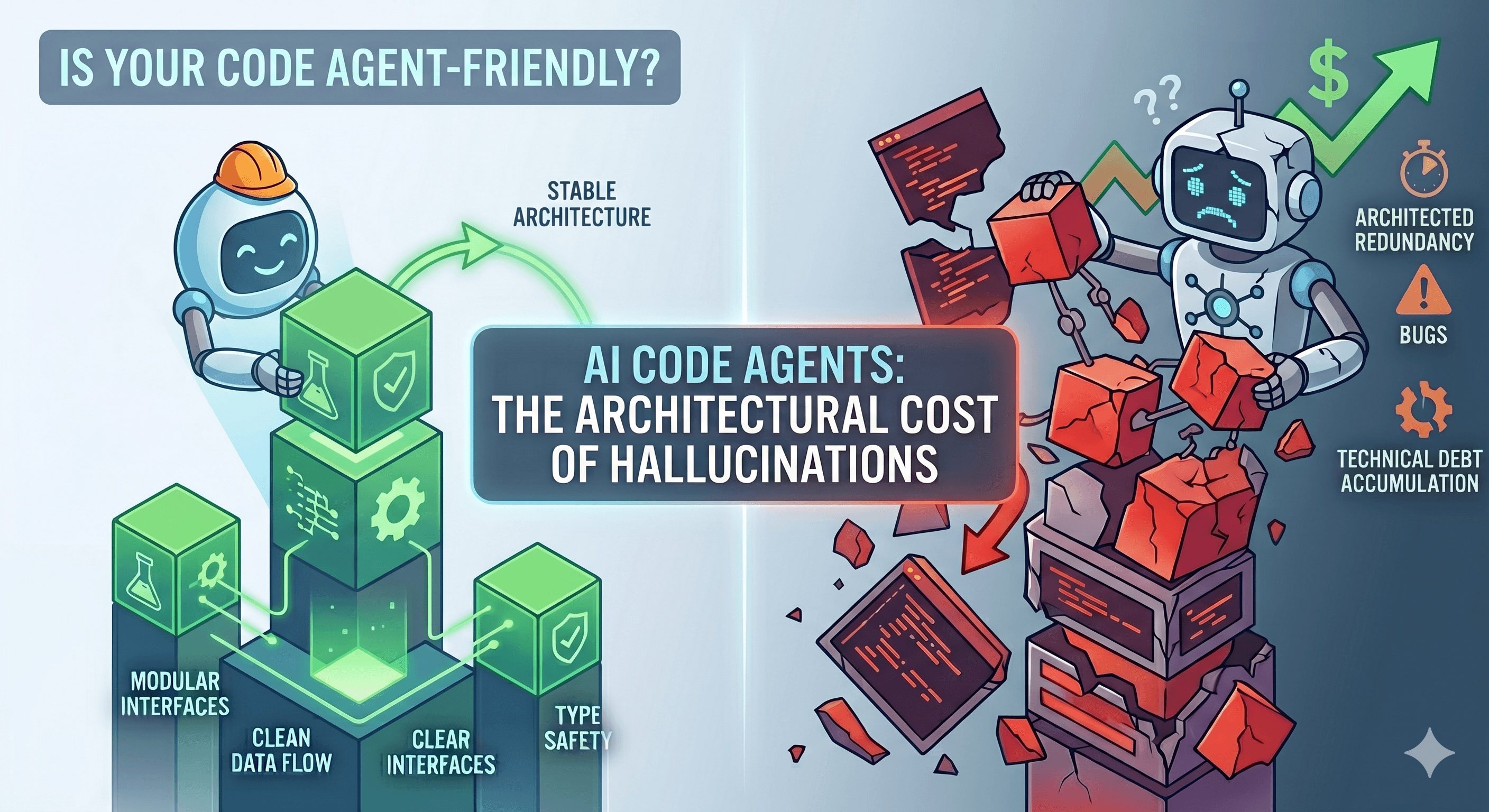
It’s 2 AM, and you’re watching an AI agent try to refactor a "simple" billing module. Suddenly, the agent starts hallucinating. It invents methods that don’t exist, deletes critical database constraints, and eventually loops into a recursive mess. You blame the AI, but as a senior engineer, you know the truth: the AI didn’t fail because it’s "dumb"—it failed because your codebase is a "Spaghetti Monolith" with no boundaries. In 2026, the cost of bad architecture isn't just "technical debt"; it’s the total failure of your autonomous workforce.
We’ve reached a tipping point where Agent-Friendly Code is no longer a luxury. As we discussed in The End of the Black Box, foundational knowledge is your only survival gear. But even with the best tools, if your code lacks clear boundaries, your agents will spend more time guessing your intent than actually building features.
1) The Context Window Trap: Why Messy Code Kills AI Reliability
AI agents operate within a "context window." When you ask an agent to fix a bug in a legacy system where business logic is buried inside a 3,000-line UI controller, you are forcing that agent to process "noise." Every unrelated import, every global variable, and every side effect eats up the agent’s reasoning capacity. This is where Agent-Friendly Code becomes a competitive advantage.
Hallucinations are Context Failures: When an agent doesn't understand where a data flow begins or ends, it fills the gaps with logic that "looks right" but is fundamentally broken.
The Noise-to-Signal Ratio: In a monolithic mess, the "noise" (boilerplate and tangled dependencies) outweighs the "signal" (the actual business rule). An agent can't help you modernize using the Ship of Theseus Advantage if it can't find the components it's supposed to replace.
Context Optimization: Clean architecture isn't just about human readability anymore; it's about "token efficiency." Modular code allows you to feed the agent exactly what it needs, and nothing more.
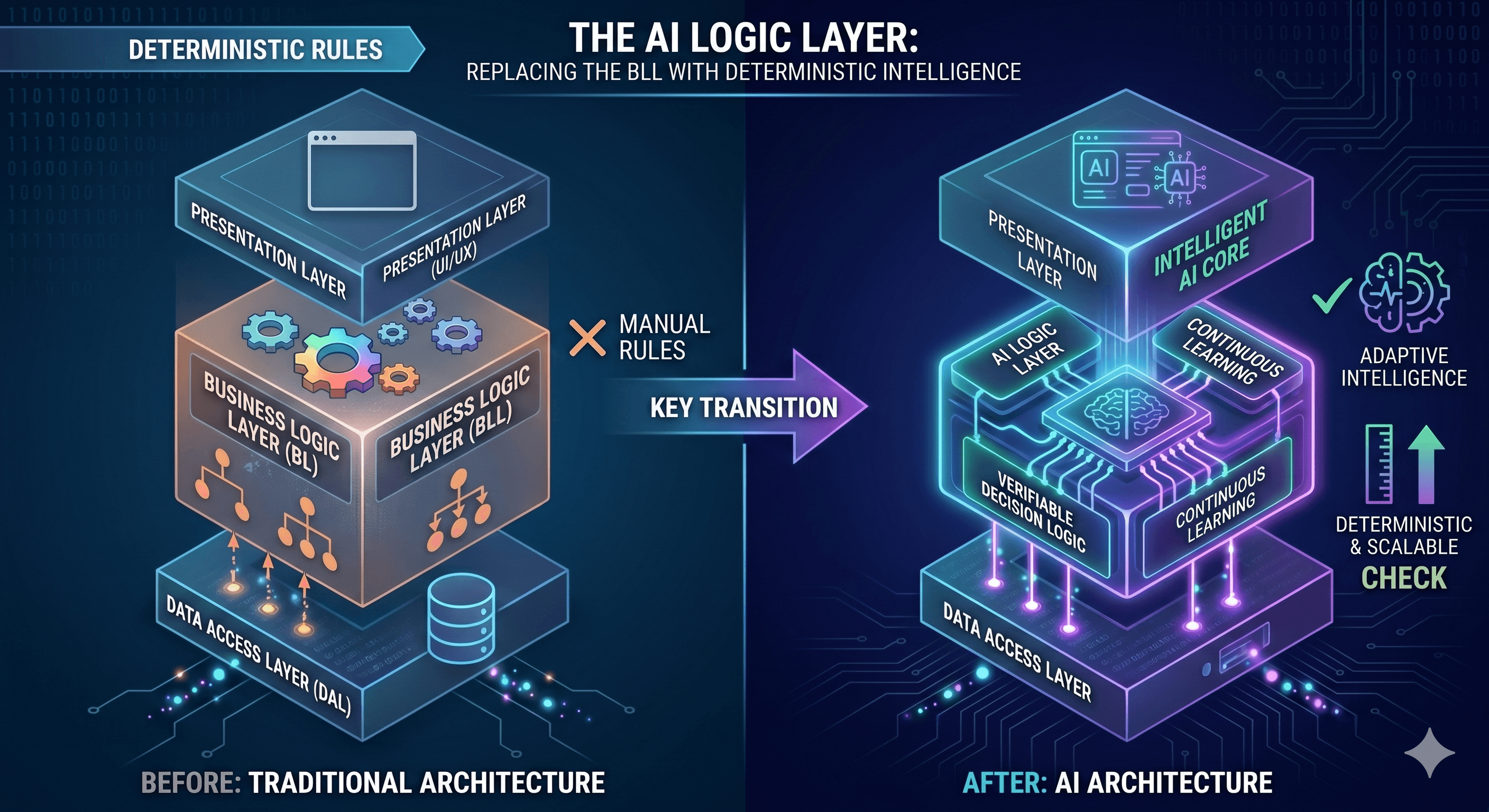
2) BLC/DALC Separation: The Secret to "Deterministic" AI
The most important step toward Agent-Friendly Code is the strict separation of concerns. In our methodology, we insist on a hard line between the Business Logic Layer (BLC) and the Data Access Layer (DALC). This isn't just a design pattern; it's a "Safe Zone" for AI.
When your BLC is "pure"—meaning it only contains business rules and doesn't know *how* the data is stored—the AI can reason about it with near-perfect accuracy. It doesn't have to worry about SQL connection strings, ORM quirks, or API headers. By providing a clean interface, you turn your codebase into a set of "LEGO blocks" that an agent can reconfigure without fear of breaking the entire system. This is the core of what we teach in our Advanced .NET Architecture training.
3) Engineering for the "Agent-First" Era
To make your codebase truly Agent-Friendly Code, you need to stop writing code for "execution" and start writing it for "orchestration." This means leveraging patterns that are inherently self-documenting and modular. For example, using the Clean Architecture principles allows agents to navigate your project structure autonomously.
If an agent can find the `/Core` domain model, the `/Application` services, and the `/Infrastructure` adapters without you pointing the way, your productivity triples. You stop being a "Prompt Engineer" and start being an "Agent Orchestrator." You aren't just fixing bugs; you are managing a fleet of specialists who understand your system as well as you do.
Conclusion: The Great Architectural Filter
The AI era is creating a "Great Filter" for software engineering. Companies with Agent-Friendly Code will move at the speed of thought, deploying features in days that used to take months. Companies with "Black Box" monoliths will be left behind, unable to leverage the AI revolution because their code is too brittle for an agent to touch.
Don't let your architecture be the bottleneck. Start applying the principles of BLC/DALC separation and modular design today. Your future self—and your AI agents—will thank you for it. Ready to master these foundations? Explore our .NET Architecture Mastery series and learn how to build systems that aren't just production-ready, but AI-ready.
It’s 2 AM, and you’re watching an AI agent try to refactor a "simple" billing module. Suddenly, the agent starts hallucinating. It invents methods that don’t exist, deletes critical database constraints, and eventually loops into a recursive mess. You blame the AI, but as a senior engineer, you know the truth: the AI didn’t fail because it’s "dumb"—it failed because your codebase is a "Spaghetti Monolith" with no boundaries. In 2026, the cost of bad architecture isn't just "technical debt"; it’s the total failure of your autonomous workforce.
We’ve reached a tipping point where Agent-Friendly Code is no longer a luxury. As we discussed in The End of the Black Box, foundational knowledge is your only survival gear. But even with the best tools, if your code lacks clear boundaries, your agents will spend more time guessing your intent than actually building features.
1) The Context Window Trap: Why Messy Code Kills AI Reliability
AI agents operate within a "context window." When you ask an agent to fix a bug in a legacy system where business logic is buried inside a 3,000-line UI controller, you are forcing that agent to process "noise." Every unrelated import, every global variable, and every side effect eats up the agent’s reasoning capacity. This is where Agent-Friendly Code becomes a competitive advantage.
Hallucinations are Context Failures: When an agent doesn't understand where a data flow begins or ends, it fills the gaps with logic that "looks right" but is fundamentally broken.
The Noise-to-Signal Ratio: In a monolithic mess, the "noise" (boilerplate and tangled dependencies) outweighs the "signal" (the actual business rule). An agent can't help you modernize using the Ship of Theseus Advantage if it can't find the components it's supposed to replace.
Context Optimization: Clean architecture isn't just about human readability anymore; it's about "token efficiency." Modular code allows you to feed the agent exactly what it needs, and nothing more.
2) BLC/DALC Separation: The Secret to "Deterministic" AI
The most important step toward Agent-Friendly Code is the strict separation of concerns. In our methodology, we insist on a hard line between the Business Logic Layer (BLC) and the Data Access Layer (DALC). This isn't just a design pattern; it's a "Safe Zone" for AI.
When your BLC is "pure"—meaning it only contains business rules and doesn't know *how* the data is stored—the AI can reason about it with near-perfect accuracy. It doesn't have to worry about SQL connection strings, ORM quirks, or API headers. By providing a clean interface, you turn your codebase into a set of "LEGO blocks" that an agent can reconfigure without fear of breaking the entire system. This is the core of what we teach in our Advanced .NET Architecture training.
3) Engineering for the "Agent-First" Era
To make your codebase truly Agent-Friendly Code, you need to stop writing code for "execution" and start writing it for "orchestration." This means leveraging patterns that are inherently self-documenting and modular. For example, using the Clean Architecture principles allows agents to navigate your project structure autonomously.
If an agent can find the `/Core` domain model, the `/Application` services, and the `/Infrastructure` adapters without you pointing the way, your productivity triples. You stop being a "Prompt Engineer" and start being an "Agent Orchestrator." You aren't just fixing bugs; you are managing a fleet of specialists who understand your system as well as you do.
Conclusion: The Great Architectural Filter
The AI era is creating a "Great Filter" for software engineering. Companies with Agent-Friendly Code will move at the speed of thought, deploying features in days that used to take months. Companies with "Black Box" monoliths will be left behind, unable to leverage the AI revolution because their code is too brittle for an agent to touch.
Don't let your architecture be the bottleneck. Start applying the principles of BLC/DALC separation and modular design today. Your future self—and your AI agents—will thank you for it. Ready to master these foundations? Explore our .NET Architecture Mastery series and learn how to build systems that aren't just production-ready, but AI-ready.