Education / AI Strategy
The Dedicated Mentor: How AI Amplifies 15 Years of Training Material Excellence
How I traded digital matches for a flamethrower to build production-ready engineers.
Written by

Rony Rizk
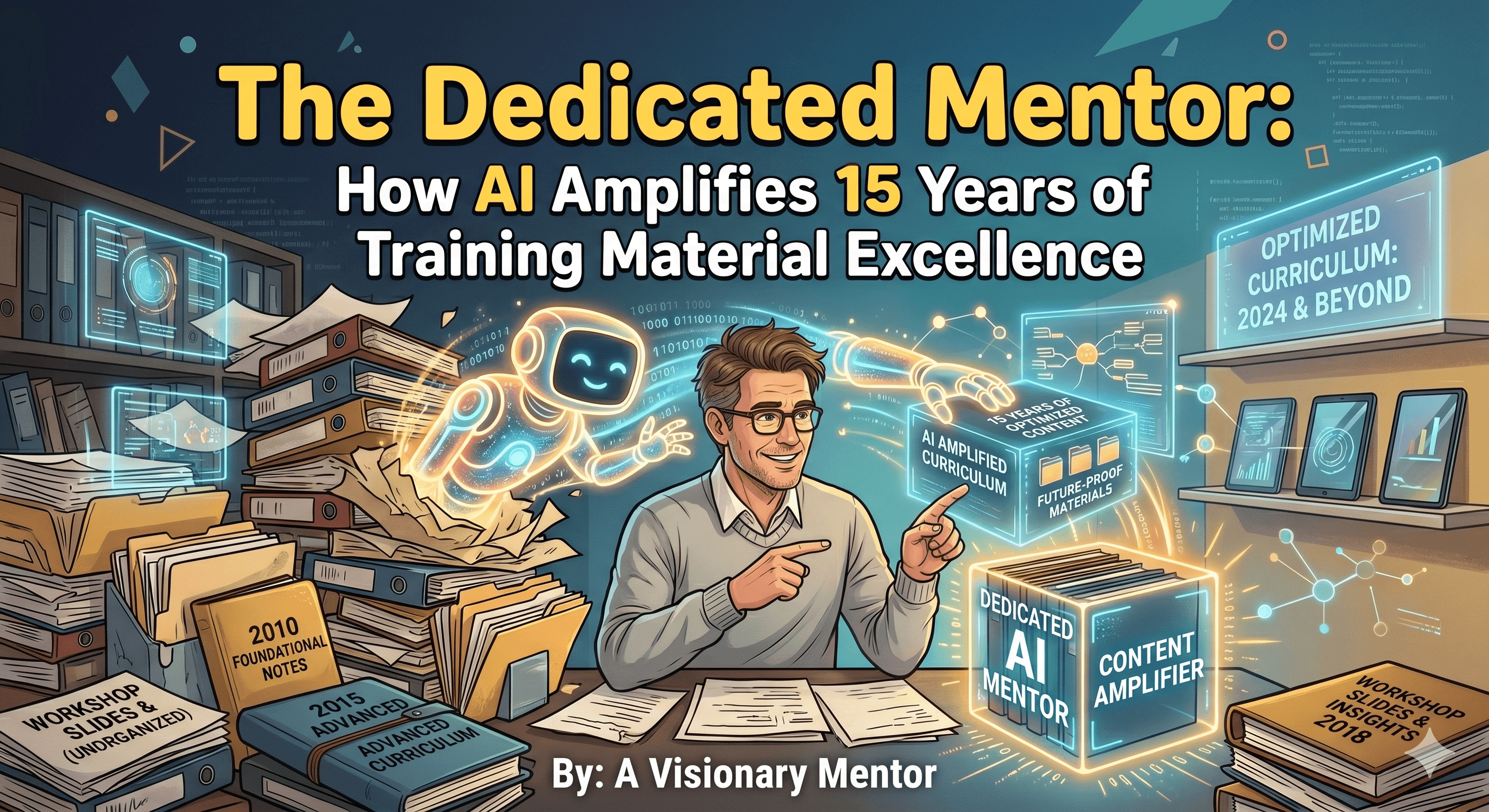
I remember 15 years ago, playing a high-stakes game of "How many laptops can I melt before I successfully simulate a database deadlock for my students?" Back then, preparing AI Enriched Training Material wasn't even a dream—it was a manual, often caffeinated, marathon of dedication. To give my students a taste of "2+ years of real-life experience," I had to play the role of a digital architect: manually breaking database configurations, scripting erratic network latency that would make a dial-up modem blush, and writing thousands of lines of boilerplate just to set the stage for a single "Aha!" moment.
The struggle wasn't just about the work; it was about the precision. Ensuring a lab was "Production-ready" meant spending 10 hours in the lab "basement" for every 1 hour of actual teaching. I was obsessed with avoiding "Hollow Experiences"—those plastic tutorials that teach you where to click but leave you with a real-world server going dark at 3 AM. Today, I’ve traded my digital matches for a flamethrower. By leveraging an AI Enriched Training Material strategy, I’m no longer just a teacher; I’m a simulation architect with a god-mode toggle.
1) The Era of Bespoke Failure
In the mid-2010s, if I wanted to teach the "Mental Models" of memory management or SQL optimization, I had to hand-craft every single bug. It was like building a Ferrari just to show someone how a spark plug misfires. My goal was always to provide a Foundational Root, but the bottleneck was my own mortality. There are only so many ways you can manually corrupt a B-tree index before you start questioning your life choices.
The "Manual" Big Data: I used to spend hours generating 500,000 rows of relational data that didn't look like a toddler's random typing. I needed realistic distributions, or the students wouldn't learn why an index actually matters.
The Troubleshooting Labyrinth: Predicting the 50 bizarre ways a student might misconfigure a Linux permissions set was a full-time job. I had to write "hint" files for scenarios that felt like they were pulled from a horror movie.
Contextual Archaeology: Digging through my own 10-year-old .NET 4.8 notes to explain why we *don't* use certain patterns anymore was a trip down a very dusty memory lane.
2) AI: The Senior Engineer’s Force Multiplier
The jump to AI hasn’t replaced my 25 years of scars; it’s just made them more useful. When I design AI Enriched Training Material today, I am performing "Intent-Based Orchestration." I don't ask the AI to "write a lab." I tell the AI: "Simulate a high-concurrency race condition in a legacy BLC that only triggers when the CPU hit is over 80%, then scaffold the Docker environment to prove it."
This isn't about laziness; it's about depth. For instance, when we discuss moving Beyond the 'Hello World' of AI, we use AI to create "Archaeological Sites"—codebases that look like they've been maintained by five different developers with five different philosophies. We can instantly inject subtle, industrial-grade bugs that would have taken me a weekend to architect manually. Now, my students spend less time watching me type and more time actually fixing production-level disasters.
3) Building "Un-Killable" Engineers
The end goal has always been to build engineers who don't blink when the terminal starts screaming. AI Enriched Training Material allows us to focus on "The Why" with a level of granularity that was previously impossible. We use AI to generate real-time comparative benchmarks—showing exactly how a 10ms query becomes a 500ms query when the data scales—without having to actually wait for the data to grow.
We aren't just teaching people to code; we are teaching them to lead. By using "industrial-grade" baseline resources and enriching them with AI-driven chaos, we ensure that the knowledge isn't just academic—it’s combat-tested. This is the core philosophy of our Linux Mastery: Full Course: if it isn't messy, you aren't learning anything that will save your job during a migration.
Conclusion: The Mentor in the Machine
15 years ago, I struggled to give my students the "scars" they needed to survive. Today, my AI assistant allows me to pour 25 years of architectural trauma into AI Enriched Training Material that evolves as fast as the frameworks do. The "Black Box" of engineering is opening, and if you have the foundational roots to understand what you're seeing, you're no longer just a developer—you're the person holding the keys.
Stop learning from "clean" tutorials. The real world is a mess. Use the AI to master the mess, or get left behind with the "Hello World" crowd.
I remember 15 years ago, playing a high-stakes game of "How many laptops can I melt before I successfully simulate a database deadlock for my students?" Back then, preparing AI Enriched Training Material wasn't even a dream—it was a manual, often caffeinated, marathon of dedication. To give my students a taste of "2+ years of real-life experience," I had to play the role of a digital architect: manually breaking database configurations, scripting erratic network latency that would make a dial-up modem blush, and writing thousands of lines of boilerplate just to set the stage for a single "Aha!" moment.
The struggle wasn't just about the work; it was about the precision. Ensuring a lab was "Production-ready" meant spending 10 hours in the lab "basement" for every 1 hour of actual teaching. I was obsessed with avoiding "Hollow Experiences"—those plastic tutorials that teach you where to click but leave you with a real-world server going dark at 3 AM. Today, I’ve traded my digital matches for a flamethrower. By leveraging an AI Enriched Training Material strategy, I’m no longer just a teacher; I’m a simulation architect with a god-mode toggle.
1) The Era of Bespoke Failure
In the mid-2010s, if I wanted to teach the "Mental Models" of memory management or SQL optimization, I had to hand-craft every single bug. It was like building a Ferrari just to show someone how a spark plug misfires. My goal was always to provide a Foundational Root, but the bottleneck was my own mortality. There are only so many ways you can manually corrupt a B-tree index before you start questioning your life choices.
The "Manual" Big Data: I used to spend hours generating 500,000 rows of relational data that didn't look like a toddler's random typing. I needed realistic distributions, or the students wouldn't learn why an index actually matters.
The Troubleshooting Labyrinth: Predicting the 50 bizarre ways a student might misconfigure a Linux permissions set was a full-time job. I had to write "hint" files for scenarios that felt like they were pulled from a horror movie.
Contextual Archaeology: Digging through my own 10-year-old .NET 4.8 notes to explain why we *don't* use certain patterns anymore was a trip down a very dusty memory lane.
2) AI: The Senior Engineer’s Force Multiplier
The jump to AI hasn’t replaced my 25 years of scars; it’s just made them more useful. When I design AI Enriched Training Material today, I am performing "Intent-Based Orchestration." I don't ask the AI to "write a lab." I tell the AI: "Simulate a high-concurrency race condition in a legacy BLC that only triggers when the CPU hit is over 80%, then scaffold the Docker environment to prove it."
This isn't about laziness; it's about depth. For instance, when we discuss moving Beyond the 'Hello World' of AI, we use AI to create "Archaeological Sites"—codebases that look like they've been maintained by five different developers with five different philosophies. We can instantly inject subtle, industrial-grade bugs that would have taken me a weekend to architect manually. Now, my students spend less time watching me type and more time actually fixing production-level disasters.
3) Building "Un-Killable" Engineers
The end goal has always been to build engineers who don't blink when the terminal starts screaming. AI Enriched Training Material allows us to focus on "The Why" with a level of granularity that was previously impossible. We use AI to generate real-time comparative benchmarks—showing exactly how a 10ms query becomes a 500ms query when the data scales—without having to actually wait for the data to grow.
We aren't just teaching people to code; we are teaching them to lead. By using "industrial-grade" baseline resources and enriching them with AI-driven chaos, we ensure that the knowledge isn't just academic—it’s combat-tested. This is the core philosophy of our Linux Mastery: Full Course: if it isn't messy, you aren't learning anything that will save your job during a migration.
Conclusion: The Mentor in the Machine
15 years ago, I struggled to give my students the "scars" they needed to survive. Today, my AI assistant allows me to pour 25 years of architectural trauma into AI Enriched Training Material that evolves as fast as the frameworks do. The "Black Box" of engineering is opening, and if you have the foundational roots to understand what you're seeing, you're no longer just a developer—you're the person holding the keys.
Stop learning from "clean" tutorials. The real world is a mess. Use the AI to master the mess, or get left behind with the "Hello World" crowd.