Backend Engineering / Production APIs
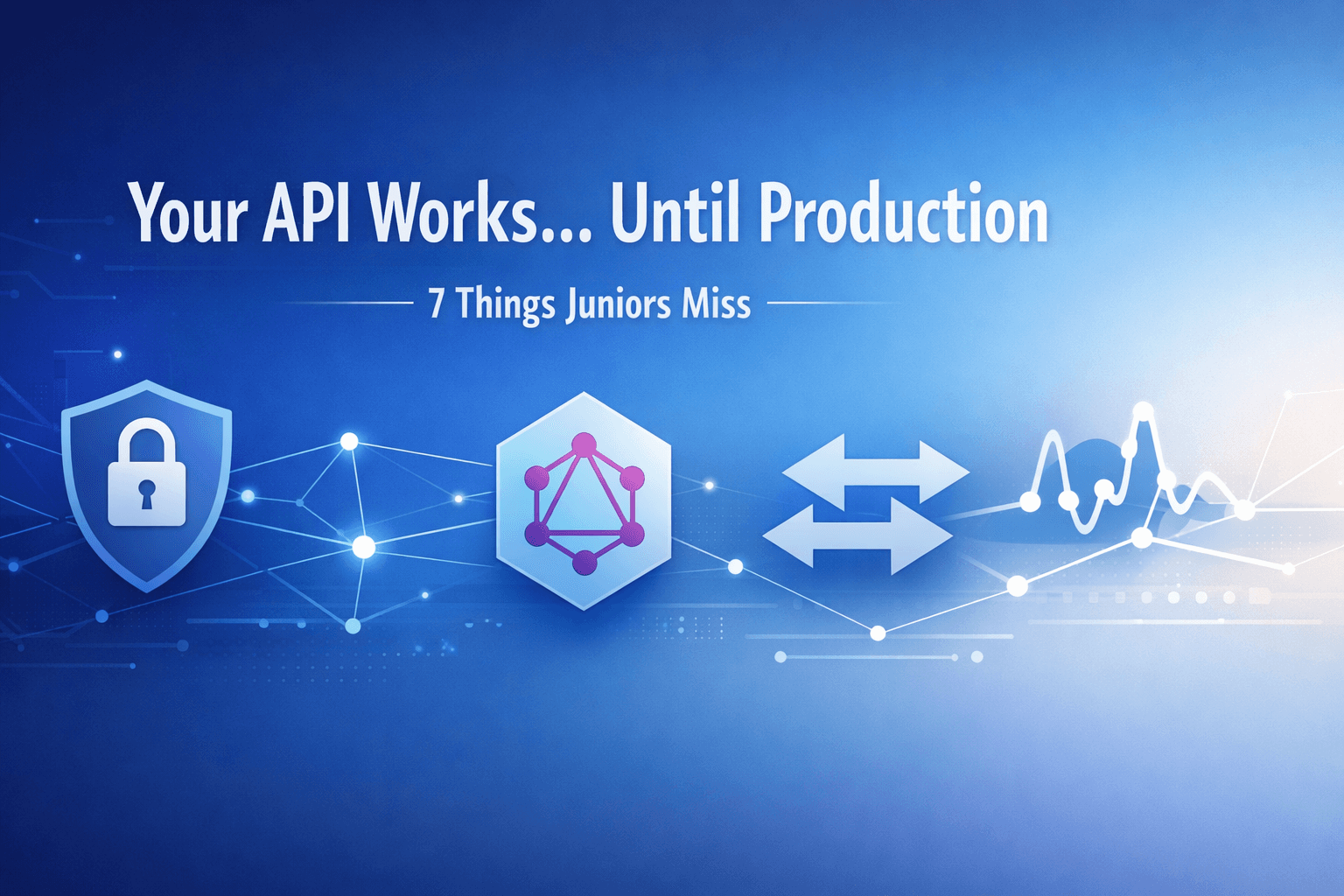
Your API Works… Until Production: The 7 Things Juniors Miss
A production mindset shift—so your APIs stay secure, scalable, and debuggable after real users arrive.
Written by

Codehouse Author
Production APIs Playbook — Part 1 of 5
Building an API that “works on localhost” is easy. Building one that survives real users, real traffic, and real incidents is a different skill set.
In production, your API isn’t judged by whether it returns JSON. It’s judged by whether teams can operate it confidently: secure access, predictable behavior, clean debugging signals, and safe changes over time. This post is a production mindset shift—and a roadmap for what to learn next.
Why “it works” isn’t the same as “it’s production-ready”
A working endpoint proves your code can respond. Production readiness proves your system can be trusted. That trust comes from four things: security, contracts, performance, and operability. If any of these are weak, you’ll feel it the first time something breaks and you can’t explain why.
The 7 production gaps that usually show up too late
1) Authentication that’s “good enough”… until it isn’t
Copy-pasting JWT middleware gets you started, but production auth is more than decoding a token. You need clear identity flows, roles/permissions, refresh tokens, and often an identity provider approach (OAuth2 / OIDC). If you can’t rotate, revoke, or safely refresh access, you’ll eventually hit security or UX issues.
2) No contract strategy (and breaking changes become chaos)
REST, GraphQL, and gRPC are not just styles—they’re contract decisions. Without a contract strategy, teams accidentally ship breaking changes, clients fail silently, and releases become risky. Stable contracts let your API evolve without turning every deployment into a gamble.
3) Performance problems hidden behind “it’s fine on my machine”
Local testing hides real bottlenecks. Production exposes them: slow database access, N+1 query patterns, inefficient serialization, missing caching, and unbounded payloads. You don’t fix this with “more servers” first—you fix it by designing how data is fetched and how responses scale.
4) No observability (so debugging becomes guessing)
If you can’t answer “what happened?” quickly, every incident turns expensive. You need logs that tell a story, metrics that reveal system health, and traces that show where time is spent across services. Without observability, you won’t know whether the issue is code, database, network, or a downstream dependency.
5) Timeouts, retries, and cancellations aren’t designed
Production calls fail. If you don’t design deadlines, retries, and cancellation, you get request pileups, cascading failures, and outages that feel random. This is one of the biggest differences between APIs that survive and APIs that melt under pressure.
6) Error handling isn’t consistent (so clients don’t know what to do)
“500: something went wrong” is not an error strategy. Production APIs return structured errors with stable codes and predictable formats. Clients need to know what is safe to retry, what requires user action, and what is a real bug. Consistency here reduces support time and improves reliability immediately.
7) You learned topics separately, but production requires integration
Most developers learn auth, API styles, and monitoring in isolation. Production skill is integration: auth + contracts + performance + resilience + observability—working together. The real test is building a system that keeps behaving under real-world conditions, not just passing a demo.
The clean learning path (what to learn next)
If you want a simple roadmap that matches real backend expectations, learn in this order:
Production Auth: OAuth2 / OIDC, refresh tokens, claims/RBAC, token strategies
GraphQL in Production: schema design, batching (DataLoader), caching, errors
gRPC in Production: protobuf, streaming, deadlines/cancellation, service-to-service patterns
Observability: logs + metrics + traces with OpenTelemetry and dashboards
Capstone Integration: build one real system that combines everything
What to do now
If you’re early in your backend journey, don’t panic—this is normal. The goal is not perfection. The goal is to build the habits that make your APIs reliable and maintainable when the stakes are real.
Production APIs Playbook — Part 1 of 5
Building an API that “works on localhost” is easy. Building one that survives real users, real traffic, and real incidents is a different skill set.
In production, your API isn’t judged by whether it returns JSON. It’s judged by whether teams can operate it confidently: secure access, predictable behavior, clean debugging signals, and safe changes over time. This post is a production mindset shift—and a roadmap for what to learn next.
Why “it works” isn’t the same as “it’s production-ready”
A working endpoint proves your code can respond. Production readiness proves your system can be trusted. That trust comes from four things: security, contracts, performance, and operability. If any of these are weak, you’ll feel it the first time something breaks and you can’t explain why.
The 7 production gaps that usually show up too late
1) Authentication that’s “good enough”… until it isn’t
Copy-pasting JWT middleware gets you started, but production auth is more than decoding a token. You need clear identity flows, roles/permissions, refresh tokens, and often an identity provider approach (OAuth2 / OIDC). If you can’t rotate, revoke, or safely refresh access, you’ll eventually hit security or UX issues.
2) No contract strategy (and breaking changes become chaos)
REST, GraphQL, and gRPC are not just styles—they’re contract decisions. Without a contract strategy, teams accidentally ship breaking changes, clients fail silently, and releases become risky. Stable contracts let your API evolve without turning every deployment into a gamble.
3) Performance problems hidden behind “it’s fine on my machine”
Local testing hides real bottlenecks. Production exposes them: slow database access, N+1 query patterns, inefficient serialization, missing caching, and unbounded payloads. You don’t fix this with “more servers” first—you fix it by designing how data is fetched and how responses scale.
4) No observability (so debugging becomes guessing)
If you can’t answer “what happened?” quickly, every incident turns expensive. You need logs that tell a story, metrics that reveal system health, and traces that show where time is spent across services. Without observability, you won’t know whether the issue is code, database, network, or a downstream dependency.
5) Timeouts, retries, and cancellations aren’t designed
Production calls fail. If you don’t design deadlines, retries, and cancellation, you get request pileups, cascading failures, and outages that feel random. This is one of the biggest differences between APIs that survive and APIs that melt under pressure.
6) Error handling isn’t consistent (so clients don’t know what to do)
“500: something went wrong” is not an error strategy. Production APIs return structured errors with stable codes and predictable formats. Clients need to know what is safe to retry, what requires user action, and what is a real bug. Consistency here reduces support time and improves reliability immediately.
7) You learned topics separately, but production requires integration
Most developers learn auth, API styles, and monitoring in isolation. Production skill is integration: auth + contracts + performance + resilience + observability—working together. The real test is building a system that keeps behaving under real-world conditions, not just passing a demo.
The clean learning path (what to learn next)
If you want a simple roadmap that matches real backend expectations, learn in this order:
Production Auth: OAuth2 / OIDC, refresh tokens, claims/RBAC, token strategies
GraphQL in Production: schema design, batching (DataLoader), caching, errors
gRPC in Production: protobuf, streaming, deadlines/cancellation, service-to-service patterns
Observability: logs + metrics + traces with OpenTelemetry and dashboards
Capstone Integration: build one real system that combines everything
What to do now
If you’re early in your backend journey, don’t panic—this is normal. The goal is not perfection. The goal is to build the habits that make your APIs reliable and maintainable when the stakes are real.