Microservices / AI Strategy
The Event-Driven Agent: Orchestrating Microservices via Kafka in 2026
Moving beyond synchronous Request-Response. Learn how Event-Driven AI Agent Orchestration is redefining the "Internal Nervous System" of modern distributed systems.
Written by
Codehouse Author
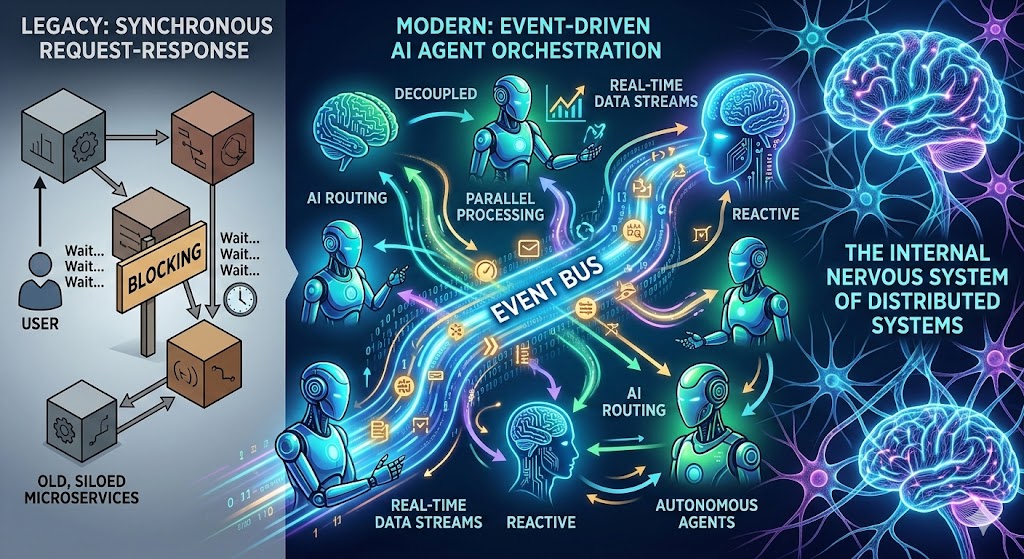
For a decade, we have lived in the world of synchronous REST calls. We built "Wait-and-See" architectures where Service A calls Service B and hangs until it receives a response. In the old world, this led to the dreaded "Distributed Monolith." But as we enter the second half of this decade, the paradigm has shifted. We are no longer just building services; we are building environments for autonomous intelligence. This evolution has given rise to Event-Driven AI Agent Orchestration, a strategy where the "nervous system" of our application isn't a series of API endpoints, but a high-performance event stream like Apache Kafka.
Building on our foundational discussion regarding the Agent Orchestrator mindset, we must now address the physical medium where these agents reside. An agent that lives inside a single request context is limited. An agent that "listens" to the entire system via a distributed log is revolutionary. By integrating agents directly into our event-driven workflows, we move from simple "if-this-then-that" logic to truly cognitive system behavior.
The Shift from Orchestration to Choreography
In traditional microservices, "Orchestration" implies a central controller telling everyone what to do. Event-Driven AI Agent Orchestration favors "Choreography." In this model, an agent doesn't wait for a command; it subscribes to topics in Apache Kafka and reacts when the system state changes. This is the ultimate expression of decoupling. For example, when a "PaymentSucceeded" event is published, three different agents might react: one to verify the fraud score, one to initiate the fulfillment process, and another to perform a sentiment analysis on the user's recent history to decide on a personalized confirmation message.
Why Agents Need the Event Log
The primary challenge of AI agents in 2026 is context. Without context, an agent is just a "smart guest" with no memory. By using an event-driven model, we provide the agent with a "Time Machine." Because Kafka retains the history of events, an agent can "replay" the last 50 events leading up to a failure. This creates a superior debugging and recovery loop:
Autonomous Root Cause Analysis: When an "ErrorOccurred" event hits the stream, the agent analyzes the preceding events to identify the culprit.
Surgical Recovery: Instead of a generic retry, the agent can decide to trigger a specific compensation workflow based on the exact failure state.
State Consistency: By leveraging the principles of Clean Architecture in .NET, we ensure that the agent's actions are isolated and don't introduce side effects into the core business logic layer.
The "Outbox Pattern" for Agents
A critical technical requirement for Event-Driven AI Agent Orchestration is reliability. You cannot risk an agent "thinking" it performed an action without the event being successfully published. We utilize the "Transactional Outbox Pattern" to ensure that the agent’s decision-making process and the resulting Kafka message are part of a single atomic transaction. This prevents the "Eventually Inconsistent" nightmare where an agent triggers a refund in the database but fails to notify the accounting service.
The future of backend engineering isn't about writing more "glue code." It is about designing the message schemas and the event boundaries that allow these agents to flourish. When you master Event-Driven AI Agent Orchestration, you stop being a "coder" and start being an "Architect of Intelligence." You aren't just managing servers; you are managing a living, breathing digital organism that learns from its own event stream.
As we continue to explore the Production API Checklist, remember that the most scalable API is often the one you don't have to call synchronously. The asynchronous, agent-led future is already here—it's just waiting for you to publish the next event.
For a decade, we have lived in the world of synchronous REST calls. We built "Wait-and-See" architectures where Service A calls Service B and hangs until it receives a response. In the old world, this led to the dreaded "Distributed Monolith." But as we enter the second half of this decade, the paradigm has shifted. We are no longer just building services; we are building environments for autonomous intelligence. This evolution has given rise to Event-Driven AI Agent Orchestration, a strategy where the "nervous system" of our application isn't a series of API endpoints, but a high-performance event stream like Apache Kafka.
Building on our foundational discussion regarding the Agent Orchestrator mindset, we must now address the physical medium where these agents reside. An agent that lives inside a single request context is limited. An agent that "listens" to the entire system via a distributed log is revolutionary. By integrating agents directly into our event-driven workflows, we move from simple "if-this-then-that" logic to truly cognitive system behavior.
The Shift from Orchestration to Choreography
In traditional microservices, "Orchestration" implies a central controller telling everyone what to do. Event-Driven AI Agent Orchestration favors "Choreography." In this model, an agent doesn't wait for a command; it subscribes to topics in Apache Kafka and reacts when the system state changes. This is the ultimate expression of decoupling. For example, when a "PaymentSucceeded" event is published, three different agents might react: one to verify the fraud score, one to initiate the fulfillment process, and another to perform a sentiment analysis on the user's recent history to decide on a personalized confirmation message.
Why Agents Need the Event Log
The primary challenge of AI agents in 2026 is context. Without context, an agent is just a "smart guest" with no memory. By using an event-driven model, we provide the agent with a "Time Machine." Because Kafka retains the history of events, an agent can "replay" the last 50 events leading up to a failure. This creates a superior debugging and recovery loop:
Autonomous Root Cause Analysis: When an "ErrorOccurred" event hits the stream, the agent analyzes the preceding events to identify the culprit.
Surgical Recovery: Instead of a generic retry, the agent can decide to trigger a specific compensation workflow based on the exact failure state.
State Consistency: By leveraging the principles of Clean Architecture in .NET, we ensure that the agent's actions are isolated and don't introduce side effects into the core business logic layer.
The "Outbox Pattern" for Agents
A critical technical requirement for Event-Driven AI Agent Orchestration is reliability. You cannot risk an agent "thinking" it performed an action without the event being successfully published. We utilize the "Transactional Outbox Pattern" to ensure that the agent’s decision-making process and the resulting Kafka message are part of a single atomic transaction. This prevents the "Eventually Inconsistent" nightmare where an agent triggers a refund in the database but fails to notify the accounting service.
The future of backend engineering isn't about writing more "glue code." It is about designing the message schemas and the event boundaries that allow these agents to flourish. When you master Event-Driven AI Agent Orchestration, you stop being a "coder" and start being an "Architect of Intelligence." You aren't just managing servers; you are managing a living, breathing digital organism that learns from its own event stream.
As we continue to explore the Production API Checklist, remember that the most scalable API is often the one you don't have to call synchronously. The asynchronous, agent-led future is already here—it's just waiting for you to publish the next event.