Backend Engineering / Telemetry
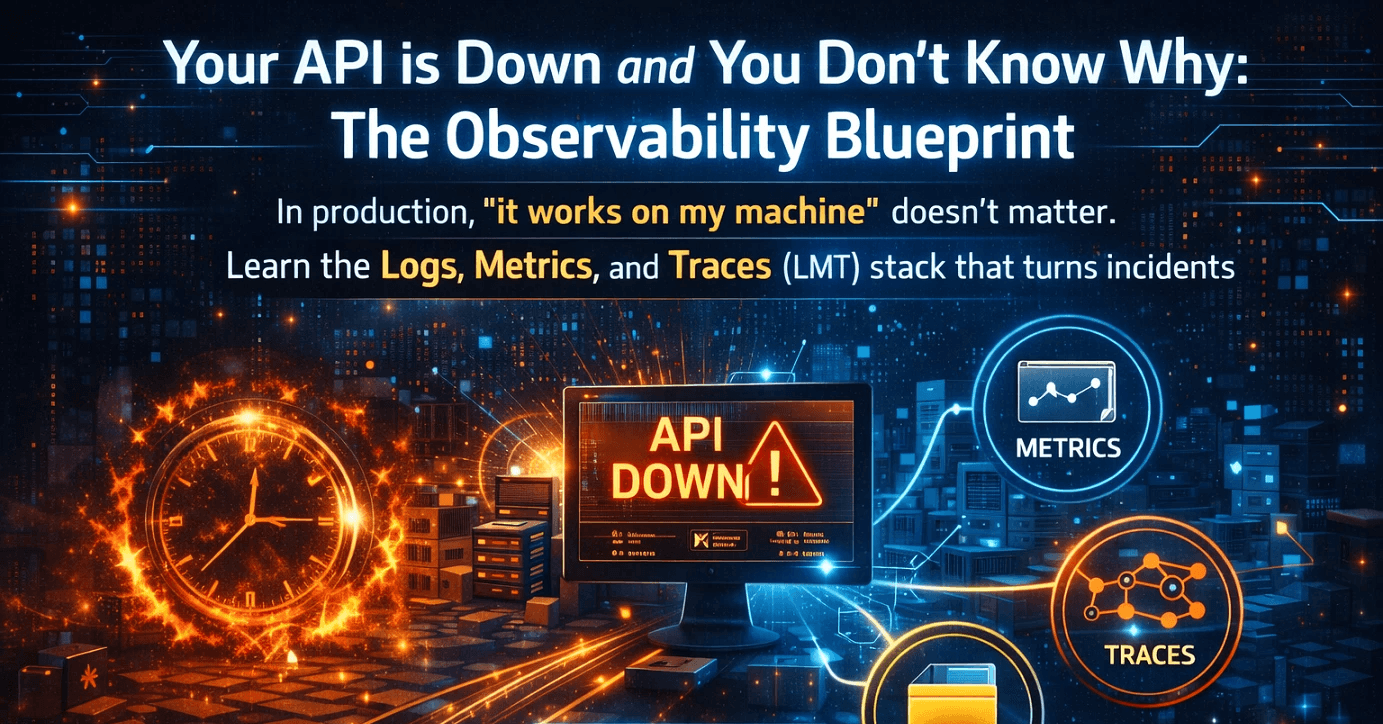
Your API is Down and You Don’t Know Why: The Observability Blueprint
In production, 'it works on my machine' doesn't matter. Learn the Logs, Metrics, and Traces (LMT) stack that turns incidents into 5-minute fixes.
Written by

Codehouse Author
Building an API is only half the battle. As we discussed in Backend Development Explained, the real test is how your system behaves under stress.
Without Observability, you are guessing. Senior engineers rely on the "Three Pillars" of observability to maintain production-grade reliability. You can find deep-dive documentation on these standards at OpenTelemetry.io.
1) Structured Logs (The "What")
Stop writing unsearchable text logs. Use structured JSON logs that allow you to filter by specific identifiers.
Request IDs: Track a single request from the load balancer to the DB.
User Context: Identify if a bug is affecting a specific user group.
Standardization: Use common field names across all services for easier querying.
2) Distributed Tracing (The "Where")
In a microservices world, tracing is the only way to see where time is spent across services, especially when using complex systems like GraphQL in Production.
Timeline view: See exactly which service is the bottleneck.
Dependency Mapping: Automatically visualize how your services talk to each other.
Building an API is only half the battle. As we discussed in Backend Development Explained, the real test is how your system behaves under stress.
Without Observability, you are guessing. Senior engineers rely on the "Three Pillars" of observability to maintain production-grade reliability. You can find deep-dive documentation on these standards at OpenTelemetry.io.
1) Structured Logs (The "What")
Stop writing unsearchable text logs. Use structured JSON logs that allow you to filter by specific identifiers.
Request IDs: Track a single request from the load balancer to the DB.
User Context: Identify if a bug is affecting a specific user group.
Standardization: Use common field names across all services for easier querying.
2) Distributed Tracing (The "Where")
In a microservices world, tracing is the only way to see where time is spent across services, especially when using complex systems like GraphQL in Production.
Timeline view: See exactly which service is the bottleneck.
Dependency Mapping: Automatically visualize how your services talk to each other.