Backend Engineering / gRPC
gRPC in Production: When to Move Beyond REST for Service-to-Service Logic
Stop using JSON for internal talk. Learn how gRPC, Protobuf, and deadlines create the reliable "internal nervous system" senior engineers prefer.
Written by

Codehouse Author
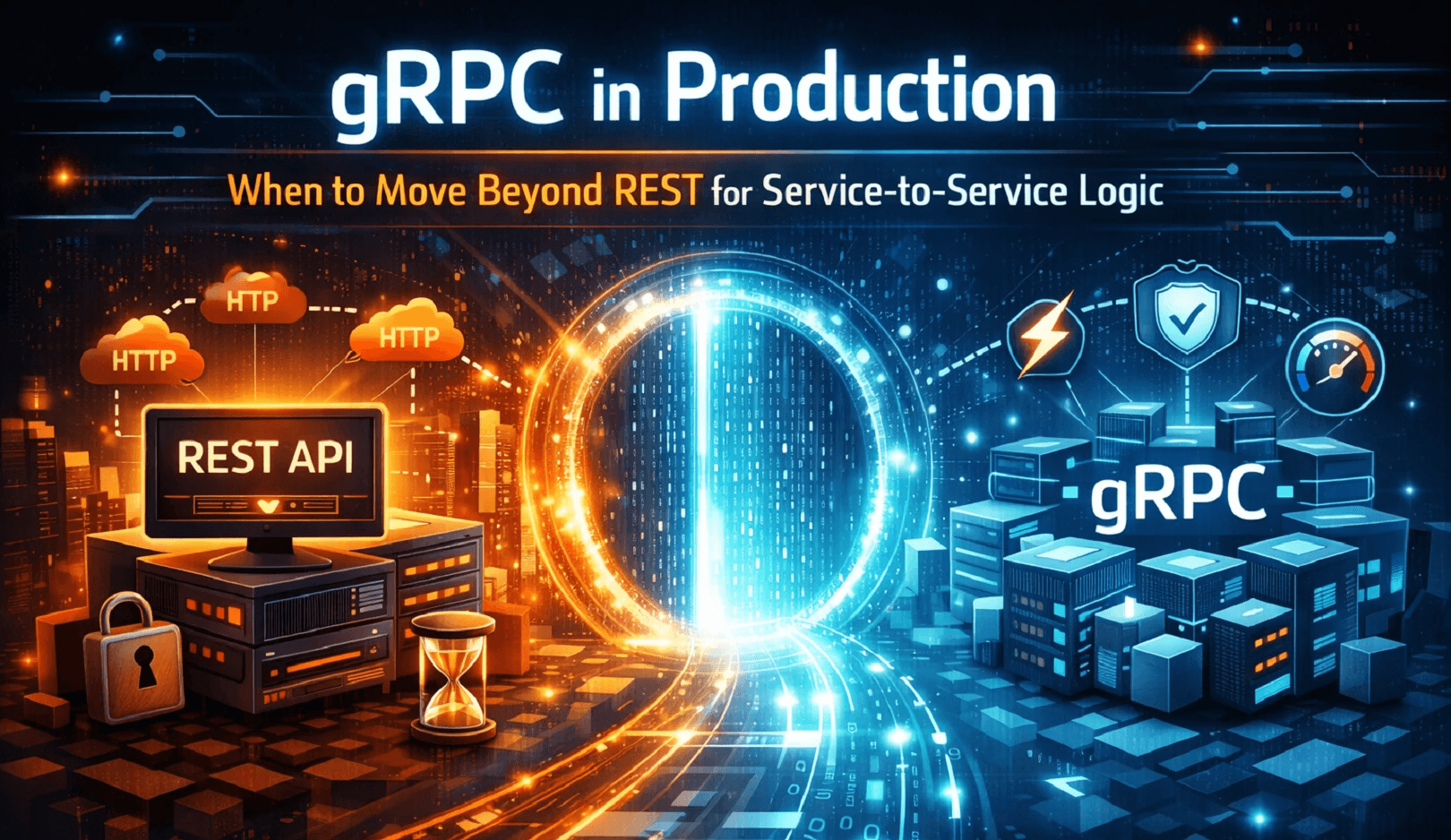
In our Production API Checklist, we discussed the importance of stable contracts. While REST is great for public consumers, your internal services need something more robust.
If you use REST/JSON for internal communication, you’re paying a "tax" in every call. This is where gRPC becomes the senior decision. It’s a high-performance framework originally developed by Google.
1) Protobuf: The Strict Contract
Unlike REST, where you hope the JSON matches the documentation, gRPC uses Protocol Buffers (Protobuf). You can read more about it on the official gRPC website.
Binary format: Smaller and faster than JSON.
Strong typing: Code is generated for both services, making it impossible to send a "string" where a "long" is expected.
2) Deadlines and Cancellations
This is a critical feature for production stability. In a complex system, you need to ensure that security context flows correctly, as we explored in our post about OAuth2 and OIDC.
Deadlines: Timeouts that travel across the entire service chain.
Cancellations: If Service A gives up, Service C automatically stops working.
In our Production API Checklist, we discussed the importance of stable contracts. While REST is great for public consumers, your internal services need something more robust.
If you use REST/JSON for internal communication, you’re paying a "tax" in every call. This is where gRPC becomes the senior decision. It’s a high-performance framework originally developed by Google.
1) Protobuf: The Strict Contract
Unlike REST, where you hope the JSON matches the documentation, gRPC uses Protocol Buffers (Protobuf). You can read more about it on the official gRPC website.
Binary format: Smaller and faster than JSON.
Strong typing: Code is generated for both services, making it impossible to send a "string" where a "long" is expected.
2) Deadlines and Cancellations
This is a critical feature for production stability. In a complex system, you need to ensure that security context flows correctly, as we explored in our post about OAuth2 and OIDC.
Deadlines: Timeouts that travel across the entire service chain.
Cancellations: If Service A gives up, Service C automatically stops working.