Backend Engineering / DevOps
Docker is Not Magic: It’s Just a Collection of Linux Features
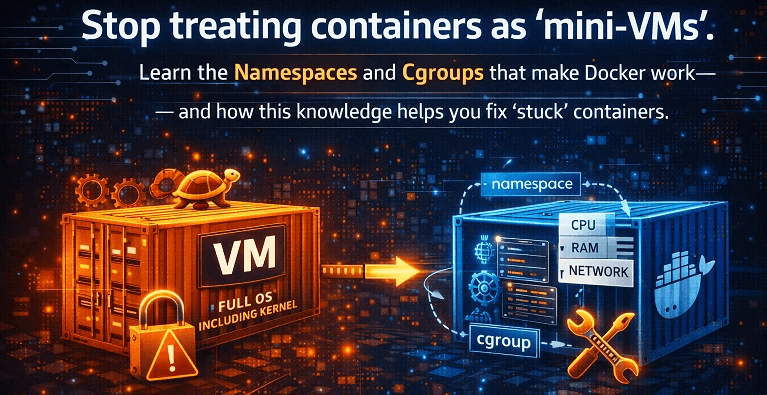
Stop treating containers as 'mini-VMs.' Learn the Namespaces and Cgroups that make Docker work—and how this knowledge helps you fix 'stuck' containers.
Written by

Codehouse Author
Docker feels like magic, but magic is hard to debug. Docker is actually a wrapper around native Linux kernel features. To master it, you first need to master the basics in our Linux Mastery: Full Course.
The core of containerization relies on isolation. You can read the technical deep-dive on container runtimes at OpenContainers.org.
1) Namespaces (Isolation)
Namespaces tell a process: "You are the only process on this machine." This is a key concept we touch upon in Backend Development Explained.
PID Namespace: Isolates process IDs so a container can't see other processes.
Net Namespace: Isolates network interfaces and routing tables.
Mount Namespace: Provides a unique view of the file system.
2) Cgroups (Resource Limits)
Control Groups (Cgroups) ensure that one container doesn't consume all the CPU or Memory, preventing the "noisy neighbor" problem in production environments. This is why Docker can run hundreds of containers on a single host without crashing.
Docker feels like magic, but magic is hard to debug. Docker is actually a wrapper around native Linux kernel features. To master it, you first need to master the basics in our Linux Mastery: Full Course.
The core of containerization relies on isolation. You can read the technical deep-dive on container runtimes at OpenContainers.org.
1) Namespaces (Isolation)
Namespaces tell a process: "You are the only process on this machine." This is a key concept we touch upon in Backend Development Explained.
PID Namespace: Isolates process IDs so a container can't see other processes.
Net Namespace: Isolates network interfaces and routing tables.
Mount Namespace: Provides a unique view of the file system.
2) Cgroups (Resource Limits)
Control Groups (Cgroups) ensure that one container doesn't consume all the CPU or Memory, preventing the "noisy neighbor" problem in production environments. This is why Docker can run hundreds of containers on a single host without crashing.