Mobile Development / Architecture
React Native vs. Flutter: Beyond the 'Hot Reload' Hype
Master Mobile Architecture: The Bridge vs. The Engine. A Senior Developer's Guide to React Native and Flutter Performance in 2026.
Written by
Codehouse Author
In our Full-Stack Developer Roadmap, we discussed the importance of choosing the right tool for the job. In mobile, that choice often comes down to React Native or Flutter. But in 2026, comparing them by syntax is a junior mistake.
Senior Engineers and Architects look at how the code talks to the hardware. As we noted in our Production API Checklist, architectural stability is what matters in the long run. In mobile, this battle is defined as The Bridge vs. The Engine.
1) React Native: The Evolution of the Bridge
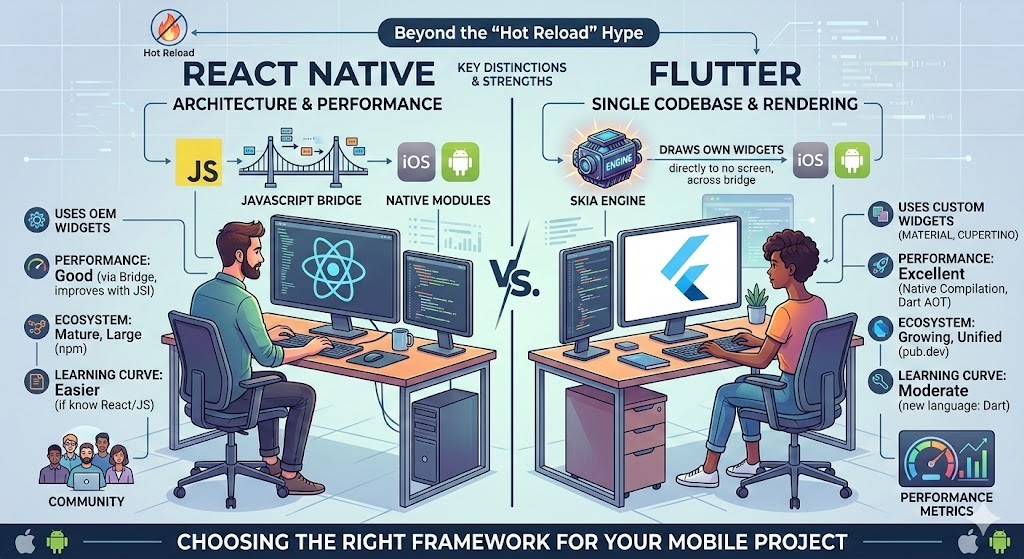
For years, React Native's biggest bottleneck was the Bridge. Every interaction required JSON serialization, creating a "tax" on every frame. However, the move to the New Architecture changed everything.
JSI (JavaScript Interface): Allows JS to hold a direct reference to C++ host objects, eliminating serialization lag.
Fabric: A new rendering system that enables synchronous UI updates, as we explored in our deep dive into Scalable Systems.
2) Flutter: The Pixel-Perfect Engine
Flutter doesn't care about native OEM widgets. It treats the screen like a canvas and paints every pixel itself. This requires a massive engineering effort, which is why Google introduced Impeller.
Impeller: A custom rendering runtime that eliminates shader compilation "jank" by pre-compiling shaders.
Zero Bridge: Communication is handled directly by the engine, providing the same 120fps consistency we aim for in High-Performance Apps.
3) Memory Management DNA
How your app handles memory determines its success on low-end devices. This is where the underlying language matters most.
Hermes (RN): A JS engine built specifically for mobile that optimizes startup time and memory footprint.
Dart (Flutter): Uses Generational Garbage Collection, which is incredibly efficient at handling short-lived objects—critical for a framework that creates thousands of widget objects per frame.
The 2026 Decision Matrix
Choosing a stack is about pragmatism, not fanboyism. Follow this senior decision matrix:
Choose React Native for apps that must feel indistinguishable from the OS or if you have a massive existing TS/React team.
Choose Flutter for "Brand-First" experiences where custom UI and high-performance animations are the core product.
Ready to dive deeper? Check out our React Native Mastery or Flutter Foundations to start building production-ready mobile apps today.
In our Full-Stack Developer Roadmap, we discussed the importance of choosing the right tool for the job. In mobile, that choice often comes down to React Native or Flutter. But in 2026, comparing them by syntax is a junior mistake.
Senior Engineers and Architects look at how the code talks to the hardware. As we noted in our Production API Checklist, architectural stability is what matters in the long run. In mobile, this battle is defined as The Bridge vs. The Engine.
1) React Native: The Evolution of the Bridge
For years, React Native's biggest bottleneck was the Bridge. Every interaction required JSON serialization, creating a "tax" on every frame. However, the move to the New Architecture changed everything.
JSI (JavaScript Interface): Allows JS to hold a direct reference to C++ host objects, eliminating serialization lag.
Fabric: A new rendering system that enables synchronous UI updates, as we explored in our deep dive into Scalable Systems.
2) Flutter: The Pixel-Perfect Engine
Flutter doesn't care about native OEM widgets. It treats the screen like a canvas and paints every pixel itself. This requires a massive engineering effort, which is why Google introduced Impeller.
Impeller: A custom rendering runtime that eliminates shader compilation "jank" by pre-compiling shaders.
Zero Bridge: Communication is handled directly by the engine, providing the same 120fps consistency we aim for in High-Performance Apps.
3) Memory Management DNA
How your app handles memory determines its success on low-end devices. This is where the underlying language matters most.
Hermes (RN): A JS engine built specifically for mobile that optimizes startup time and memory footprint.
Dart (Flutter): Uses Generational Garbage Collection, which is incredibly efficient at handling short-lived objects—critical for a framework that creates thousands of widget objects per frame.
The 2026 Decision Matrix
Choosing a stack is about pragmatism, not fanboyism. Follow this senior decision matrix:
Choose React Native for apps that must feel indistinguishable from the OS or if you have a massive existing TS/React team.
Choose Flutter for "Brand-First" experiences where custom UI and high-performance animations are the core product.
Ready to dive deeper? Check out our React Native Mastery or Flutter Foundations to start building production-ready mobile apps today.