Testing / AI
The Playwright Revolution: Testing Web Apps in the Era of AI
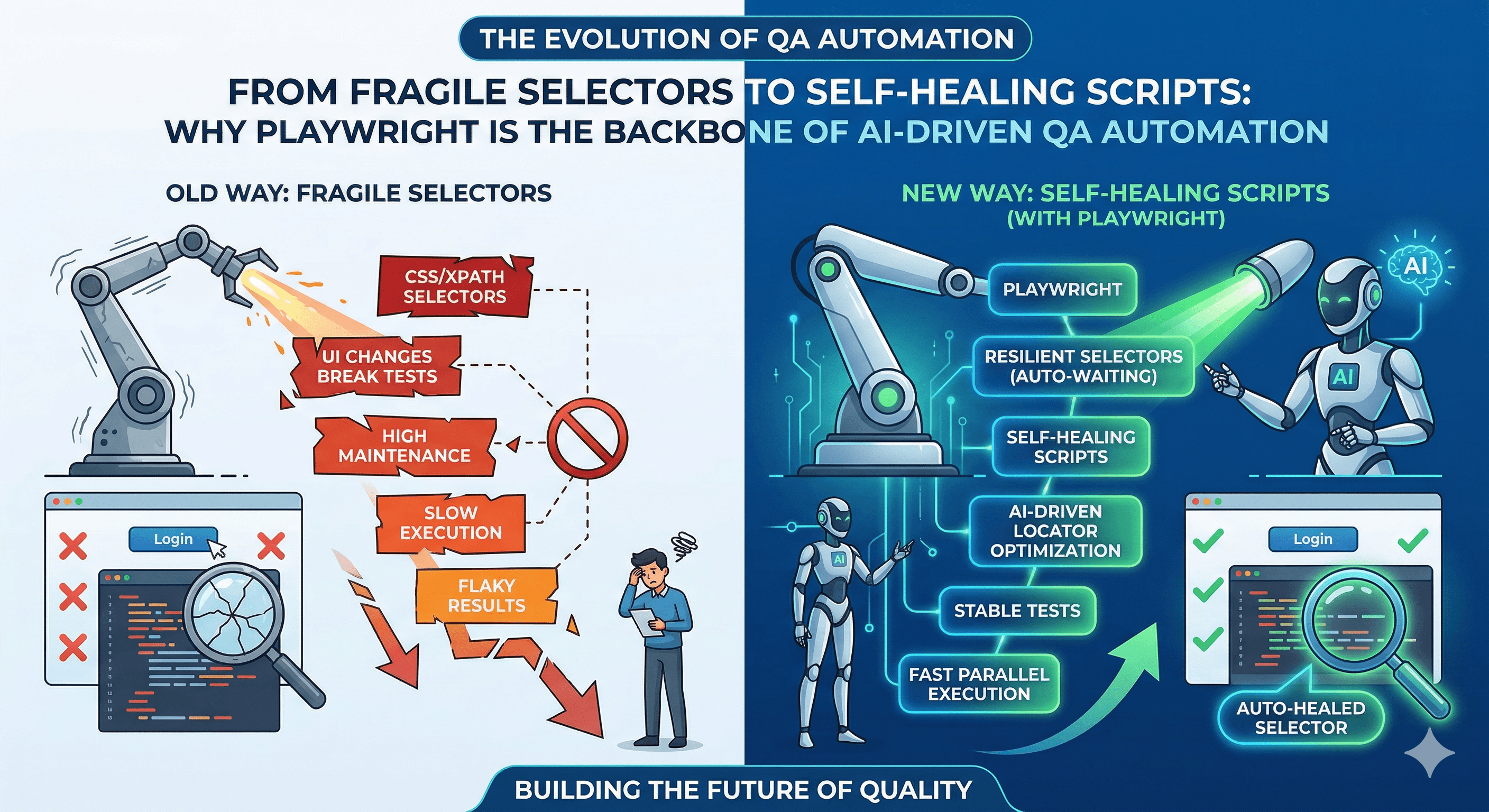
From fragile selectors to self-healing scripts—why Playwright is the backbone of AI-driven QA automation.
Written by
Codehouse Author
Testing web applications used to be about finding the right CSS selector and hoping it didn’t change in the next release. But in 2026, the landscape has shifted. With the rise of Generative UIs and AI-integrated applications, the traditional "hardcoded" approach to testing is dying. Enter Playwright: the modern standard that is rapidly evolving into an AI-powered testing engine.
If you are still struggling with flaky tests or slow execution in Selenium, you are falling behind. As we discussed in our Testing React Native with Detox and AI post, the industry is moving toward "Intelligent QA"—where the test framework is smart enough to handle dynamic content without breaking. Playwright is at the heart of this movement.
1) Why Playwright is the AI Era's Native Framework
Playwright wasn't just built for speed; it was built for the complexity of modern web components. Its native support for Shadow DOM, automatic waiting, and isolation makes it the perfect host for AI testing tools. Unlike older frameworks, Playwright treats the browser as a first-class citizen, allowing for deep introspection that AI models can leverage to understand the page structure.
In our Testing & QA Automation course, we emphasize that the best tests are the ones that survive UI changes. Playwright’s Trace Viewer and Codegen features provide the perfect data foundation for training AI models to recognize intent rather than just coordinates.
2) The Rise of AI Extensions: ZeroStep and Beyond
The real "magic" happens when you plug AI directly into your Playwright scripts. Extensions like ZeroStep are changing the game. Instead of writing complex locator logic, you can write natural language instructions:
await ai('Click on the login button and sign in using the demo user account');
await ai('Verify that the dashboard shows a 25% increase in traffic');
await ai('Click on the login button and sign in using the demo user account');
await ai('Verify that the dashboard shows a 25% increase in traffic');
These AI Extensions use LLMs to translate your intent into Playwright actions on the fly. This means your test suite can actually *understand* the UI, making it incredibly resilient to small design tweaks or A/B testing variations.
3) "Self-Healing" Tests: The End of Maintenance Nightmares
One of the biggest costs in QA is test maintenance. When a developer changes a class name, 50 tests might break. AI-powered Playwright setups now feature Self-Healing capabilities. If a primary selector fails, the AI can analyze the DOM, identify the most likely candidate for the target element, and continue the test—all while logging a suggestion to update the code.
This "Surgical Automation" mirrors the senior workflow we explored in AI Automation for Daily Tasks. It turns testing from a bottleneck into a high-speed safety net.
4) Testing AI with AI
Finally, how do you test an application that *uses* AI? If your app generates text or images, a simple "equal to" assertion won't work. By using Playwright in combination with LLM-based assertions, you can verify the semantic correctness of your application's output. You can ask an AI agent to "Verify that the generated summary accurately reflects the data in the table," and have Playwright execute that verification in the browser environment.
The era of "Manual QA" isn't just ending—it's being upgraded. By mastering Playwright and its AI ecosystem, you aren't just writing tests; you are building an autonomous quality gate for the next generation of software.
Testing web applications used to be about finding the right CSS selector and hoping it didn’t change in the next release. But in 2026, the landscape has shifted. With the rise of Generative UIs and AI-integrated applications, the traditional "hardcoded" approach to testing is dying. Enter Playwright: the modern standard that is rapidly evolving into an AI-powered testing engine.
If you are still struggling with flaky tests or slow execution in Selenium, you are falling behind. As we discussed in our Testing React Native with Detox and AI post, the industry is moving toward "Intelligent QA"—where the test framework is smart enough to handle dynamic content without breaking. Playwright is at the heart of this movement.
1) Why Playwright is the AI Era's Native Framework
Playwright wasn't just built for speed; it was built for the complexity of modern web components. Its native support for Shadow DOM, automatic waiting, and isolation makes it the perfect host for AI testing tools. Unlike older frameworks, Playwright treats the browser as a first-class citizen, allowing for deep introspection that AI models can leverage to understand the page structure.
In our Testing & QA Automation course, we emphasize that the best tests are the ones that survive UI changes. Playwright’s Trace Viewer and Codegen features provide the perfect data foundation for training AI models to recognize intent rather than just coordinates.
2) The Rise of AI Extensions: ZeroStep and Beyond
The real "magic" happens when you plug AI directly into your Playwright scripts. Extensions like ZeroStep are changing the game. Instead of writing complex locator logic, you can write natural language instructions:
await ai('Click on the login button and sign in using the demo user account');
await ai('Verify that the dashboard shows a 25% increase in traffic');
These AI Extensions use LLMs to translate your intent into Playwright actions on the fly. This means your test suite can actually *understand* the UI, making it incredibly resilient to small design tweaks or A/B testing variations.
3) "Self-Healing" Tests: The End of Maintenance Nightmares
One of the biggest costs in QA is test maintenance. When a developer changes a class name, 50 tests might break. AI-powered Playwright setups now feature Self-Healing capabilities. If a primary selector fails, the AI can analyze the DOM, identify the most likely candidate for the target element, and continue the test—all while logging a suggestion to update the code.
This "Surgical Automation" mirrors the senior workflow we explored in AI Automation for Daily Tasks. It turns testing from a bottleneck into a high-speed safety net.
4) Testing AI with AI
Finally, how do you test an application that *uses* AI? If your app generates text or images, a simple "equal to" assertion won't work. By using Playwright in combination with LLM-based assertions, you can verify the semantic correctness of your application's output. You can ask an AI agent to "Verify that the generated summary accurately reflects the data in the table," and have Playwright execute that verification in the browser environment.
The era of "Manual QA" isn't just ending—it's being upgraded. By mastering Playwright and its AI ecosystem, you aren't just writing tests; you are building an autonomous quality gate for the next generation of software.