Real-Time Systems / Backend Engineering
Node.js Socket.io vs. .NET Core SignalR: Choosing Your Real-Time Engine (2026)
Real-time isn't just about WebSockets. Compare the two giants of the real-time web and learn which one fits your production architecture.
Written by

Codehouse Author
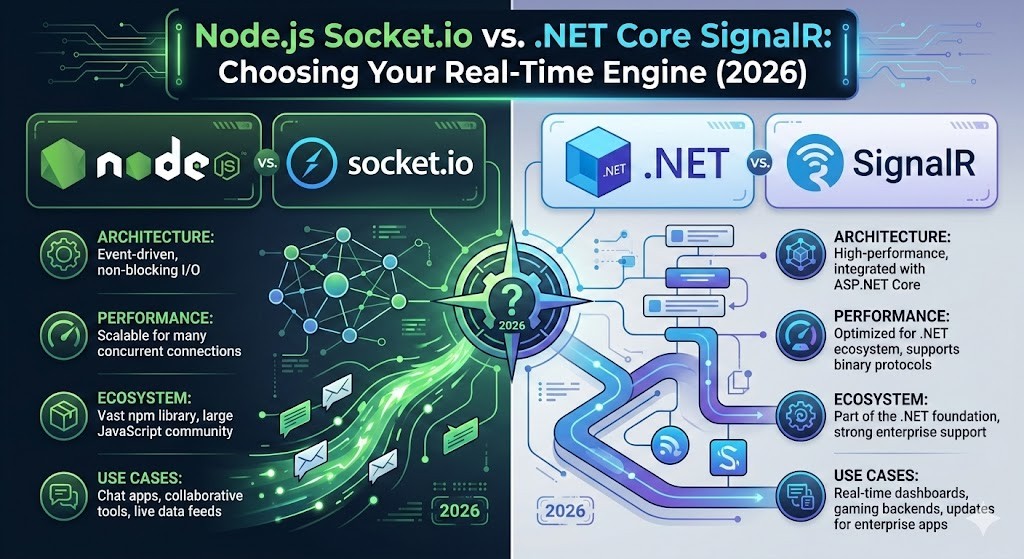
In 2026, "Real-Time" is no longer a luxury feature—it is a baseline expectation. Whether you are building a collaborative AI pair-programming tool, a high-frequency trading dashboard, or a multi-player gaming backend, the choice between Node.js Socket.io vs .NET Core SignalR will define your system's scalability and maintenance tail. While both frameworks aim to solve the "persistent connection" problem, they do so with fundamentally different philosophies and architectural constraints.
As we explored in our deep dive into Node.js Parallelism and Worker Threads, the runtime environment dictates how you handle high-concurrency workloads. Real-time servers are unique because they are stateful by nature; you aren't just processing a request and forgetting it—you are maintaining a heartbeat with thousands of clients simultaneously.
Socket.io: The Event-Driven JavaScript Pioneer
Socket.io has been the "de facto" standard for JavaScript developers for over a decade. Its greatest strength is its simplicity and its "Event-Driven" DNA. In Socket.io, everything is an event. You don't call methods; you emit and listen for named packets. This aligns perfectly with the asynchronous nature of Node.js.
Auto-Fallback: Socket.io is famous for its robust fallback mechanism. If a corporate firewall blocks WebSockets, it seamlessly downgrades to HTTP Long Polling without the developer writing a single line of extra code.
The "Rooms" Abstraction: Socket.io makes broadcasting to specific groups incredibly easy. "Joining a room" is a first-class citizen, making it a favorite for chat applications and collaborative editors.
Ecosystem: Being part of the npm ecosystem means integration with Redis for scaling (using the @socket.io/redis-adapter) is trivial.
SignalR: The Industrial-Strength .NET Powerhouse
When discussing Node.js Socket.io vs .NET Core SignalR, SignalR represents the "strongly-typed" architectural approach. Built directly into the ASP.NET Core framework, it leverages the full power of the .NET type system, Dependency Injection (DI), and multi-threading capabilities. For more on the structured approach to .NET development, see our post on Clean Architecture in .NET.
Hubs vs. Events: Unlike Socket.io’s string-based events, SignalR uses "Hubs." A Hub is a class where you define methods that the client can call directly. This provides a "Remote Procedure Call" (RPC) feel that is much easier to debug and refactor in large enterprise codebases.
Automatic Transport Negotiation: SignalR is even more aggressive than Socket.io with transports. It supports WebSockets, Server-Sent Events (SSE), and Long Polling, negotiating the best possible connection automatically.
Binary Protocols: SignalR supports MessagePack out of the box. This binary serialization format is significantly faster and smaller than the JSON-based packets used by default in Socket.io, making it the superior choice for high-throughput telemetry.
Scaling the Real-Time Layer
The real battle in Node.js Socket.io vs .NET Core SignalR happens when you need to move beyond a single server. Since connections are stateful, Server A doesn't know about the clients connected to Server B. Both frameworks solve this using a "Backplane."
In the Node.js world, Redis is the undisputed king of the backplane. In the .NET world, while Redis is supported, many architects prefer the Azure SignalR Service, which offloads the entire connection management to a managed cloud service, allowing your web servers to remain stateless. This is a critical distinction for those enrolled in our Caching, Messaging, and Real-Time Systems course—choosing the right backplane is often more important than the framework itself.
Performance and Resource Utilization
In a head-to-head performance test, .NET Core SignalR often takes the lead in raw throughput and memory efficiency per connection, thanks to the .NET 8/9 optimizations like System.IO.Pipelines and Span<T>. However, Node.js Socket.io often has a lower "barrier to entry" for developers who are already working in a full-stack JavaScript environment.
If your application requires complex business logic to be executed during the real-time loop (e.g., validating a move in a chess game against a database), the multi-threaded nature of .NET allows you to handle these calculations without blocking the heartbeat of other connected users. In Node.js, you must be careful not to block the event loop, often necessitating the worker threads we discussed previously.
Final Verdict: Which Should You Choose?
The Node.js Socket.io vs .NET Core SignalR debate usually comes down to your existing stack and the complexity of your messages. Use Socket.io if you need rapid prototyping, a pure JavaScript stack, or if your application relies heavily on dynamic, unstructured events. Choose SignalR if you are building an enterprise-grade system that requires strong typing, binary serialization, and deep integration with a .NET backend.
To dive deeper into the technical implementation of these patterns, check out the official SignalR documentation and compare it with the Socket.io approach. In the world of production real-time systems, the best tool is the one that stays connected when the network gets messy.
In 2026, "Real-Time" is no longer a luxury feature—it is a baseline expectation. Whether you are building a collaborative AI pair-programming tool, a high-frequency trading dashboard, or a multi-player gaming backend, the choice between Node.js Socket.io vs .NET Core SignalR will define your system's scalability and maintenance tail. While both frameworks aim to solve the "persistent connection" problem, they do so with fundamentally different philosophies and architectural constraints.
As we explored in our deep dive into Node.js Parallelism and Worker Threads, the runtime environment dictates how you handle high-concurrency workloads. Real-time servers are unique because they are stateful by nature; you aren't just processing a request and forgetting it—you are maintaining a heartbeat with thousands of clients simultaneously.
Socket.io: The Event-Driven JavaScript Pioneer
Socket.io has been the "de facto" standard for JavaScript developers for over a decade. Its greatest strength is its simplicity and its "Event-Driven" DNA. In Socket.io, everything is an event. You don't call methods; you emit and listen for named packets. This aligns perfectly with the asynchronous nature of Node.js.
Auto-Fallback: Socket.io is famous for its robust fallback mechanism. If a corporate firewall blocks WebSockets, it seamlessly downgrades to HTTP Long Polling without the developer writing a single line of extra code.
The "Rooms" Abstraction: Socket.io makes broadcasting to specific groups incredibly easy. "Joining a room" is a first-class citizen, making it a favorite for chat applications and collaborative editors.
Ecosystem: Being part of the npm ecosystem means integration with Redis for scaling (using the @socket.io/redis-adapter) is trivial.
SignalR: The Industrial-Strength .NET Powerhouse
When discussing Node.js Socket.io vs .NET Core SignalR, SignalR represents the "strongly-typed" architectural approach. Built directly into the ASP.NET Core framework, it leverages the full power of the .NET type system, Dependency Injection (DI), and multi-threading capabilities. For more on the structured approach to .NET development, see our post on Clean Architecture in .NET.
Hubs vs. Events: Unlike Socket.io’s string-based events, SignalR uses "Hubs." A Hub is a class where you define methods that the client can call directly. This provides a "Remote Procedure Call" (RPC) feel that is much easier to debug and refactor in large enterprise codebases.
Automatic Transport Negotiation: SignalR is even more aggressive than Socket.io with transports. It supports WebSockets, Server-Sent Events (SSE), and Long Polling, negotiating the best possible connection automatically.
Binary Protocols: SignalR supports MessagePack out of the box. This binary serialization format is significantly faster and smaller than the JSON-based packets used by default in Socket.io, making it the superior choice for high-throughput telemetry.
Scaling the Real-Time Layer
The real battle in Node.js Socket.io vs .NET Core SignalR happens when you need to move beyond a single server. Since connections are stateful, Server A doesn't know about the clients connected to Server B. Both frameworks solve this using a "Backplane."
In the Node.js world, Redis is the undisputed king of the backplane. In the .NET world, while Redis is supported, many architects prefer the Azure SignalR Service, which offloads the entire connection management to a managed cloud service, allowing your web servers to remain stateless. This is a critical distinction for those enrolled in our Caching, Messaging, and Real-Time Systems course—choosing the right backplane is often more important than the framework itself.
Performance and Resource Utilization
In a head-to-head performance test, .NET Core SignalR often takes the lead in raw throughput and memory efficiency per connection, thanks to the .NET 8/9 optimizations like System.IO.Pipelines and Span<T>. However, Node.js Socket.io often has a lower "barrier to entry" for developers who are already working in a full-stack JavaScript environment.
If your application requires complex business logic to be executed during the real-time loop (e.g., validating a move in a chess game against a database), the multi-threaded nature of .NET allows you to handle these calculations without blocking the heartbeat of other connected users. In Node.js, you must be careful not to block the event loop, often necessitating the worker threads we discussed previously.
Final Verdict: Which Should You Choose?
The Node.js Socket.io vs .NET Core SignalR debate usually comes down to your existing stack and the complexity of your messages. Use Socket.io if you need rapid prototyping, a pure JavaScript stack, or if your application relies heavily on dynamic, unstructured events. Choose SignalR if you are building an enterprise-grade system that requires strong typing, binary serialization, and deep integration with a .NET backend.
To dive deeper into the technical implementation of these patterns, check out the official SignalR documentation and compare it with the Socket.io approach. In the world of production real-time systems, the best tool is the one that stays connected when the network gets messy.