Backend Performance / Distributed Systems
Memcached vs Redis: Architecting the Ultimate Performance Layer (2026)
Choosing a cache isn't just about speed—it's about the data structures and threading models that power your scale.
Written by

Codehouse Author
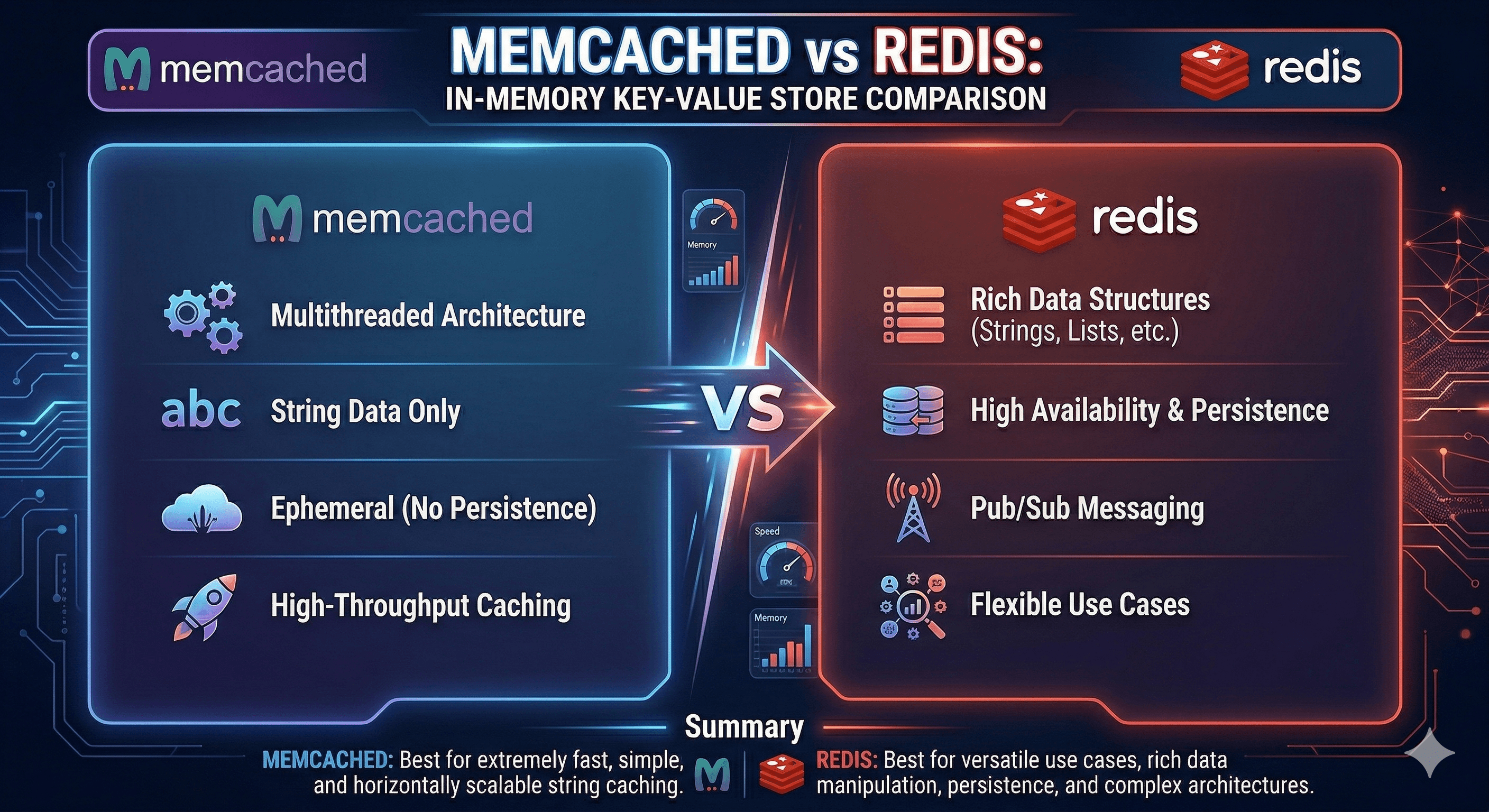
In the high-stakes world of 2026 backend engineering, the question isn't whether you should cache, but where. As systems move toward agentic architectures and real-time data processing, the debate of Memcached vs Redis remains more relevant than ever. While both tools reside in the "In-Memory" category, their internal philosophies dictate entirely different performance profiles for your production workloads.
Why do we need distributed caching in the first place? As we discussed in our exploration of Node.js Parallelism and Worker Threads, your primary database is often the bottleneck. By offloading frequently accessed data to a dedicated memory layer, you reduce latency from milliseconds to microseconds. However, picking the wrong engine can lead to memory fragmentation or single-threaded bottlenecks that are difficult to fix once the traffic hits.
Memcached: The Multi-Threaded Specialist
Memcached is the "purest" form of a cache. It is designed with a single goal: to be a simple, high-performance, key-value store. Its most significant architectural advantage in the Memcached vs Redis comparison is its multi-threaded nature. Because Memcached can leverage multiple CPU cores simultaneously, it excels at handling massive amounts of small, static data like session strings or rendered HTML fragments.
Slab Allocation: Memcached uses a sophisticated memory management system called "Slab Allocation" to prevent memory fragmentation. This makes it incredibly predictable under heavy load.
Horizontal Scaling: It is designed to be "dead simple" to scale out. You simply add more nodes to the cluster, and the client handles the hashing.
Low Overhead: With no complex data structures or persistence logic, Memcached has significantly lower CPU and memory overhead compared to its peers.
Redis: The Data Structure Swiss Army Knife
Redis is often described not just as a cache, but as a "Remote Data Structure Server." In the Memcached vs Redis debate, Redis wins on versatility every time. It supports Lists, Sets, Hashes, Geospatial indexes, and even Streams. For engineers following our Clean Architecture in .NET patterns, Redis often serves as a shared state manager across microservices.
Persistence: Unlike Memcached, which is strictly volatile, Redis offers RDB (snapshots) and AOF (append-only file) persistence. This allows it to act as a primary database for transient data.
Advanced Features: Built-in Pub/Sub, Lua scripting, and transactions allow you to move complex logic into the memory layer itself.
Rich Ecosystem: With Redis Stack and Redis JSON, the engine has evolved into a multi-model powerhouse that can handle everything from search to graph data.
The Rule of 4: Real-World Use Cases
To truly understand the Memcached vs Redis trade-off, we must look at where these tools shine in the field. Here are four distinct scenarios that define the choice:
High-Throughput Session Storage: If you are running a global e-commerce platform with millions of users and only need to store simple session strings, Memcached's multi-threading allows it to handle more requests per second on fewer nodes.
Real-Time Gaming Leaderboards: Redis is the undisputed king here. Using "Sorted Sets" (ZSETs), you can rank millions of players and retrieve their positions in logarithmic time—a task that would require complex application-level logic in Memcached.
API Response Caching: For static JSON responses that don't change frequently, Memcached provides a lightweight "set-and-forget" layer that won't distract your CPU from business logic.
Distributed Locking for Microservices: When preventing race conditions across multiple instances (e.g., ensuring a payment is only processed once), Redis's atomic operations (like SETNX) make it the industry standard for distributed locking and coordination.
Performance and Threading Models
A common myth in the Memcached vs Redis comparison is that Redis is always faster. In reality, while Redis is incredibly fast, it is primarily single-threaded (though recent versions have introduced multi-threaded I/O). This means a single "expensive" command can block the entire server. Memcached, being natively multi-threaded, is often more resilient to "noisy neighbor" patterns in multi-tenant environments.
For those enrolled in our Caching, Messaging, and Real-Time Systems course, we deep-dive into how to tune these parameters for 99.9th percentile latency. Choosing between them usually comes down to whether you need a simple "bucket" for data (Memcached) or a sophisticated "engine" to manipulate data (Redis).
Final Verdict: Choosing Your Engine
The choice between Memcached vs Redis is a matter of architectural intent. Use Memcached if you need a rock-solid, simple, and multi-threaded key-value store for high-demand, static data. Choose Redis if you require complex data types, persistence, or advanced messaging patterns. Both have their place in a modern stack, and in many large-scale architectures, you will find them running side-by-side.
To explore the full technical specifications of these data types, refer to the official Redis documentation. Mastering these memory layers is the first step toward building systems that don't just work, but scale effortlessly under pressure.
In the high-stakes world of 2026 backend engineering, the question isn't whether you should cache, but where. As systems move toward agentic architectures and real-time data processing, the debate of Memcached vs Redis remains more relevant than ever. While both tools reside in the "In-Memory" category, their internal philosophies dictate entirely different performance profiles for your production workloads.
Why do we need distributed caching in the first place? As we discussed in our exploration of Node.js Parallelism and Worker Threads, your primary database is often the bottleneck. By offloading frequently accessed data to a dedicated memory layer, you reduce latency from milliseconds to microseconds. However, picking the wrong engine can lead to memory fragmentation or single-threaded bottlenecks that are difficult to fix once the traffic hits.
Memcached: The Multi-Threaded Specialist
Memcached is the "purest" form of a cache. It is designed with a single goal: to be a simple, high-performance, key-value store. Its most significant architectural advantage in the Memcached vs Redis comparison is its multi-threaded nature. Because Memcached can leverage multiple CPU cores simultaneously, it excels at handling massive amounts of small, static data like session strings or rendered HTML fragments.
Slab Allocation: Memcached uses a sophisticated memory management system called "Slab Allocation" to prevent memory fragmentation. This makes it incredibly predictable under heavy load.
Horizontal Scaling: It is designed to be "dead simple" to scale out. You simply add more nodes to the cluster, and the client handles the hashing.
Low Overhead: With no complex data structures or persistence logic, Memcached has significantly lower CPU and memory overhead compared to its peers.
Redis: The Data Structure Swiss Army Knife
Redis is often described not just as a cache, but as a "Remote Data Structure Server." In the Memcached vs Redis debate, Redis wins on versatility every time. It supports Lists, Sets, Hashes, Geospatial indexes, and even Streams. For engineers following our Clean Architecture in .NET patterns, Redis often serves as a shared state manager across microservices.
Persistence: Unlike Memcached, which is strictly volatile, Redis offers RDB (snapshots) and AOF (append-only file) persistence. This allows it to act as a primary database for transient data.
Advanced Features: Built-in Pub/Sub, Lua scripting, and transactions allow you to move complex logic into the memory layer itself.
Rich Ecosystem: With Redis Stack and Redis JSON, the engine has evolved into a multi-model powerhouse that can handle everything from search to graph data.
The Rule of 4: Real-World Use Cases
To truly understand the Memcached vs Redis trade-off, we must look at where these tools shine in the field. Here are four distinct scenarios that define the choice:
High-Throughput Session Storage: If you are running a global e-commerce platform with millions of users and only need to store simple session strings, Memcached's multi-threading allows it to handle more requests per second on fewer nodes.
Real-Time Gaming Leaderboards: Redis is the undisputed king here. Using "Sorted Sets" (ZSETs), you can rank millions of players and retrieve their positions in logarithmic time—a task that would require complex application-level logic in Memcached.
API Response Caching: For static JSON responses that don't change frequently, Memcached provides a lightweight "set-and-forget" layer that won't distract your CPU from business logic.
Distributed Locking for Microservices: When preventing race conditions across multiple instances (e.g., ensuring a payment is only processed once), Redis's atomic operations (like SETNX) make it the industry standard for distributed locking and coordination.
Performance and Threading Models
A common myth in the Memcached vs Redis comparison is that Redis is always faster. In reality, while Redis is incredibly fast, it is primarily single-threaded (though recent versions have introduced multi-threaded I/O). This means a single "expensive" command can block the entire server. Memcached, being natively multi-threaded, is often more resilient to "noisy neighbor" patterns in multi-tenant environments.
For those enrolled in our Caching, Messaging, and Real-Time Systems course, we deep-dive into how to tune these parameters for 99.9th percentile latency. Choosing between them usually comes down to whether you need a simple "bucket" for data (Memcached) or a sophisticated "engine" to manipulate data (Redis).
Final Verdict: Choosing Your Engine
The choice between Memcached vs Redis is a matter of architectural intent. Use Memcached if you need a rock-solid, simple, and multi-threaded key-value store for high-demand, static data. Choose Redis if you require complex data types, persistence, or advanced messaging patterns. Both have their place in a modern stack, and in many large-scale architectures, you will find them running side-by-side.
To explore the full technical specifications of these data types, refer to the official Redis documentation. Mastering these memory layers is the first step toward building systems that don't just work, but scale effortlessly under pressure.