Backend Engineering / Caching
The Cache Invalidation Nightmare: How to Use Redis Without Losing Data
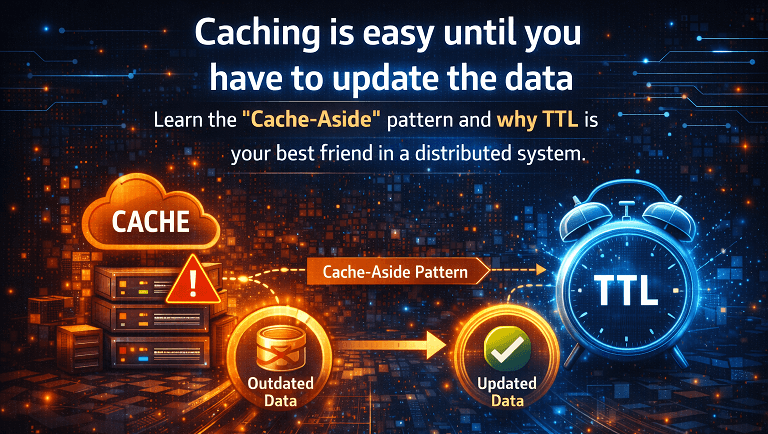
Caching is easy until you have to update the data. Learn the 'Cache-Aside' pattern and why TTL is your best friend in a distributed system.
Written by

Codehouse Author
Caching makes your app feel fast, but stale data makes your app feel broken. As we noted in our Backend Explained post, the database is often the bottleneck.
The most reliable way to handle high-traffic keys is through a Cache-Aside strategy. You can see how industry leaders handle this by reading the Redis Caching Documentation.
1) The Cache-Aside Pattern
Don't let your application wait on the cache. Follow this 3-step loop, which is a staple in any Full-Stack Developer Roadmap:
Check: Look for the data in the cache first.
Fetch: If it's not there, read from the Database.
Update: Write the result back to the cache for the next user.
2) TTL: Your Safety Net
Every cache entry must have a Time-To-Live (TTL). It ensures that even if your invalidation logic has a bug, the system eventually corrects itself.
Without a TTL, a single failed "delete cache" operation during a database update can leave your users seeing wrong data indefinitely. Senior engineers treat TTL as a non-negotiable insurance policy.
Caching makes your app feel fast, but stale data makes your app feel broken. As we noted in our Backend Explained post, the database is often the bottleneck.
The most reliable way to handle high-traffic keys is through a Cache-Aside strategy. You can see how industry leaders handle this by reading the Redis Caching Documentation.
1) The Cache-Aside Pattern
Don't let your application wait on the cache. Follow this 3-step loop, which is a staple in any Full-Stack Developer Roadmap:
Check: Look for the data in the cache first.
Fetch: If it's not there, read from the Database.
Update: Write the result back to the cache for the next user.
2) TTL: Your Safety Net
Every cache entry must have a Time-To-Live (TTL). It ensures that even if your invalidation logic has a bug, the system eventually corrects itself.
Without a TTL, a single failed "delete cache" operation during a database update can leave your users seeing wrong data indefinitely. Senior engineers treat TTL as a non-negotiable insurance policy.